Chapter 2: Revolution and War!
In 1914, not far away from my home, the war started, and we were overrun with troops. They were advancing and retreating all round us for a year, but in August 1915 the Germans came for good. We got so used to our soldiers that we were taken by surprise when we were told we must move as the Germans were very near. I was staying with friends at the time, and we rode our horses for thirty miles to the nearest railway station. We left the horses there at the station and got through a window of the last train before the bridge over the river Neman was blown up. I cried, because I did not know who would feed and water my horse that night. I was too young to see the bigger tragedy of it all.
The people squeezed into our train were leaving behind them their orderly normal life and all their belongings accumulated for generations to become wanderers, refugees, a helpless mass of humanity with never enough to eat, with no secure homes of their own again. We were taken to the nearest town then we were "unloaded".
The Army was retreating fast, crowding the roads, and there was no room for us on the trains; they were used for carrying soldiers and war staff. So we just moved along as best we could, and like locusts we ate everything on the way although there was not much left to eat by that time. The old and the weak fell sick and died; very often they were abandoned before they died because we had to move on with the army who were still retreating. Then we all invaded a little town that was kind to us; but they had not much to eat themselves. We washed ourselves and our clothes and had one or two meals, at least I did, but perhaps not everyone. From there they gave a few tickets every day to the refugees to go by train to whatever destination they chose. I went to Moscow as I had an uncle there. I was lucky to get the ticket very quickly.
I was in Moscow for three months then went to Petrograd to stay with my aunt. She took in two of my cousins, also refugees, and we all went to school together. As I was young and healthy I forgot all my bad experiences and settled down to my new life and enjoyed it very much. My aunt was a busy woman running a hospital, but she did everything to make our life happy. We had parties of young people and went out to the ballet, opera and theatre. We also did some relief work for the refugees. In 1916 my mother died. She was staying near Kazan on the river Volga. I had not seen her since I left home. She did not tell me she was ill, so the telegram I received was a great shock.
It was the first real tragedy in my life. I loved my mother. A year later, I went to see the place where she died. It was the summer of 1917, after the revolution, and the place was deserted. The owners had left, fearing trouble from the peasants. Nobody had been near the place and all the drives and paths were overgrown with weeds. Some deer were wandering about; they were very friendly and came to me. Then I found an old man mending a fence. I asked him where the owners were but he did not know. He had stayed on because he was born there and had been a gardener there all his life as his father had been before him. He had nowhere to go and all the other servants had gone to different places. Some had got work, some were still wandering. Most of them had gone to the big towns and had managed to get some rations and were roaming the streets listening to the political orators who were numerous at that time.
I had better go back to February 1917. A great deal has been said and written about that revolutionary time so perhaps there is not much for me to add. I will just tell how it affected our life. My relatives did not belong to any political party. They did not approve of the behaviour of the Tsar and Tsarina and certain ministers, they thought that it was an evil that could not be helped, that it must go on for a time, because the war was demanding all the country's strength and so they could not put their house right at the time.
Evidently the majority were not as patient, and decided otherwise; for better or worse history will tell. The days of revolution were very brief. We youngsters were terribly excited. We went out all day long, finding out what we could. We saw police being discovered armed with ammunition and often machine guns in attics or on the roofs, and we saw them being led away to prison.
There was no violence or disorder, everybody was terribly serious and composed. Now and then we had to hide behind a train or dodge into a doorway because of sudden machine gun fire or rifle fire from one of the houses. In three days all this was over, and the streets were crowded with rejoicing young people and wistful old ones. There were a lot of cars going about throwing leaflets to the crowd - very enthusiastic messages they were. We all worshipped Kerensky and his associates. A portrait of him in a leather jacket was everywhere. There was a tremendous procession at the funeral of the revolutionary heroes and I bought a beautiful red crep-de-chine blouse for the occasion. The roads were very slushy with melting snow. My feet were wet all day long and I had little to eat as I was too excited to eat my breakfast and we marched hours and hours in a procession, singing revolutionary songs and carrying flags and banners. When we got home we could not understand our elders being sad and wistful. They said "There is more to come", and they were right. You cannot alter a big country from one regime to another without sacrifices. The operation is painful and gives a big shock and it must take time to recover.
All summer the older people were expecting something to happen. The administrators were so young, everything had to be adjusted. Everybody tried to assert themselves, everybody had equal rights and meant to claim them, and as there were many unbalanced people, all restraint and all sense of proportion were lost.
Everyone was tired; the strains of the war and shortages of food were making themselves felt. The prisons were open, the criminals were free, and nobody could check their activities. People began to wander about; there was no system, much less any system for grouping the population, and chaos began. One problem was the many soldiers going about idle. They had come from the front after three years in the trenches, and they meant to enjoy themselves. In August 1917 I was sent to Crimea. It took me six days to get from Petrograd to Yevpatoria, the trains were so crowded.
In the south, things were outwardly peaceful and warm, and I loved being there. The sea was blue, the food was plentiful and the fruits were delicious; they were a luxury that the ordinary people had not been able to obtain for a long time. We had been fortunate in having a cook whose husband was a soldier and so we had been able to get a lot of extra bread and other things.
There were many war invalids recuperating and many women with children. Nobody bothered much about the political situation; they just enjoyed the peace and the sunshine. Then, we heard that General Kerensky was marching on Petrograd, and soon after that, the Post Office got disorganised. The only news came by people who got away from Petrograd.
Fewer and fewer people arrived from the north and we did not know what was happening. Later in the autumn everybody began to make up his mind what he was going to do. Some went back to the north, others went to friends and relatives in the Crimea and the Caucasus to wait until the situation became more settled. I had no news of my people, and nearly all my money was spent. I made friends with a lady Doctor who was living there with her children, the oldest of whom was a little girl of five who was recovering from meningitis. Her husband was in Petrograd and she was worried about him and we used to talk together. Her husband however managed to get through, and they decided to go to Baku where his people were living. The old people had gone to Baku fifty years before to start a goldsmith's business. They had then to travel with a military convoy as the country was unsafe. The Tartars were very lawless and the Russian Government had to keep many troops in the Caucasus and Crimea. Nearly all the officers were young aristocrats who for various social "slips" had been sent out there. Two of our greatest poets were among those there: Pushkin and Lermontov. Their sorrow was turned to the joy of future generations, for during this banishment they wrote poetry that has made their names immortal. It is in the cage that a canary sings best. The sorrow of banishment and the incomparable beauty of the Caucasus inspired those poems that to a Russian will always be a heavenly message. The Caucasus is indeed inspiring; in all my travels I have not seen any place to equal it.
My new friend and her husband did not like leaving me alone in Petrograd, so they invited me to accompany them and stay with them until I could get into touch with my people. This is one of the many instances of protective kindness that were bestowed on me of which I was so often in need. When things were hopelessly bad there was always someone to give me a hand; that has been my fortune all my life. I thank my friends the world over for their kind generosity.
I went with these friends to Baku. The train was packed and we could only manage to get the children into the carriages; we ourselves had to stand nearly the whole journey, there was not even room to sit on the floor. But the view was so magnificent that I did not mind the smell and the noise and the bruises I got from the soldiers' knapsacks as they squeezed their way through.
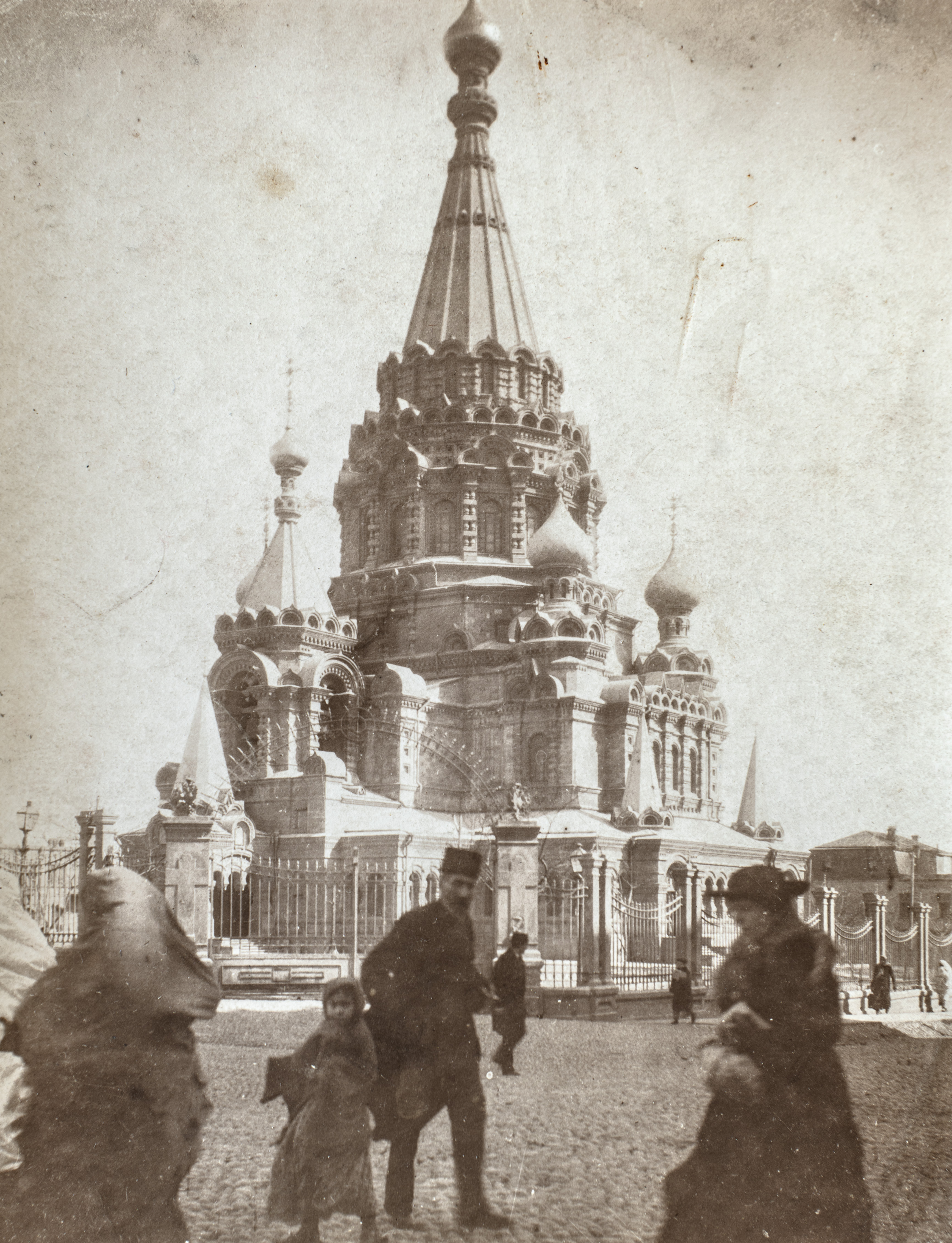
We passed Mount Kazbeck early in the morning. The sun was just rising and the rays gilded the mountain top and the whole chain of smaller mountains. It was indeed a picture never to be forgotten, I wish I could see it again. I was rather disappointed in Baku, perhaps because I had expected something very wonderful. It was the first word of four letters that I wrote unaided when I was a child. I asked what it meant, and I was told that it was a wonderful town, on the Caspian sea where people worship fires. The oil comes up through a hole in the ground and catches fire, the Zoroastrian people worship this fire. Also you can set the sea alight by throwing a burning match on the water. It is quite true that you can light oil floating on the sea, but it is not very romantic. The black oil floats on the surface of the sea all round Baku, and after bathing you have to use special soap to get the oil out of your skin, and if you go for a row you have to be very careful not to get your clothes black with this "Mazut"! The oil wells are very rich and they send up tremendous fountains into the sky. Sometimes these catch fire, and it lights everything for miles around. I was surprised that with all that wealth, they had not made the town more presentable. There was a little garden in the middle of the European quarters, where the nurses brought their charges to play every day, and the mothers came to watch their children and to gossip. There was also a fine promenade by the sea along which in the mornings and, at night, all the population used to stroll. There was quite a good theatre, and an opera house. At that time they had some very fine singers, most of whom had drifted into Baku away from the Civil War.
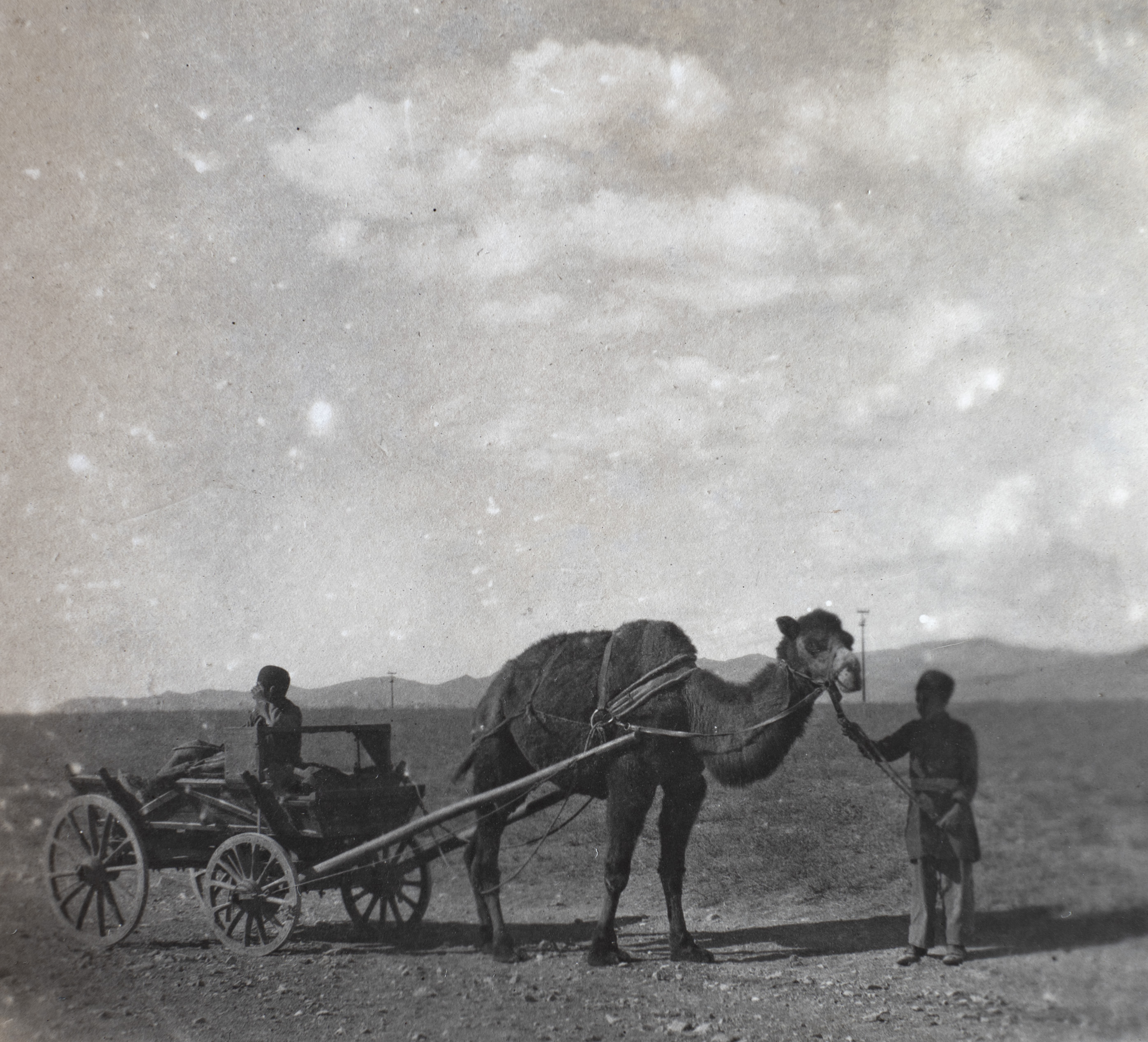
Otherwise the town was very unimposing. Narrow streets had dusty looking houses on either side. True, the houses were much better indoors, with courtyards, big rooms and verandahs. The population consisted chiefly of Tartars, Armenians, and Jews, and a few Russian government officials. I should imagine that at some time there had been foreigners because there were a lot of foreign oil concerns. The climate most of the year is pleasant but for a short time in winter there are terrific rains; I have sometimes seen the streets running like rivers. Extremely steady winds used to blow for two or three days at a time, bringing sand from the hills all around Baku, and we had to cover our faces and wear goggles because the sand stings like shot. Not much happened for the first ten months I was there, except that the supplies of food grew very short.
The shops were empty and closed. All trade was done by "mespochiniki" - the sack traders. They used to go by boat into Persia, buy things, smuggle them back into Baku, and sell them to their acquaintances at very high prices. I should say that by these means, the European population fed the other half. I don't know who ran the town, I should say it just ran itself. Everybody was so busy looking for food that there was no time to do anything else. My hosts managed to get enough to keep moderately well. We had to divide everything. The most and the best we gave to the children and the old grandparents, and the rest we shared with the servant Matrena, who had been with them for many years, and who would not part from the children. Poor Matrena used to secretly save up titbits and give them to her favourite, Georgie, who could look very appealing when there was food about. He was too young to see that she was starving. When any of us caught her feeding him and told her not to be a goose she would say,
"I am not hungry, I had some tea with the watchman's wife".
She used to say she was the fattest of all of us. "Let him have it, he needs it, I am old and can do with less. I am not growing".
Poor soul, she died a few months afterwards.
In the spring of 1918 we had a "little show" of our own in Baku. I don't know what it was all about. I think it was a local political dispute, and one of the parties got hold of the artillery, and we had a war in the town for three days. There was a rumour that the town would be bombarded that evening. It was Sunday and a lovely afternoon, my host's niece said to me that we ought to go and see what it was all about. We went to the promenade, but there was not the usual Sunday crowd; it was deserted, except for a few stray dogs running about. An extraordinary sight to see it empty on a lovely Sunday afternoon! However, we were not going to be done out of our usual stroll, and we walked right to the end. I should imagine we were a strange sight, laughing and joking in that dead stillness, and the people living in houses overlooking the place must have thought us mad. At six o'clock the big guns started shelling into the Tartars' quarters all round the bazaar, and in every street, rifle firing started. We ran into the shelter of the nearest porch but it was locked so we tried another but the doors of course were locked everywhere. We dodged from street to street, bullets singing past us, but we never saw anyone or heard anything except the noise of the firing. Then we heard shrieks and saw crowds rushing towards us. We saw the open gate of a big yard and we slipped in. There were a few little houses and we went into one of them which was empty. We waited until the crowd had gone by, and were just going out when we heard a baby cry.
We looked around and found a baby in a basket; it had just wakened and was crying. It was a very small baby and we did not know what to do with it. I picked it up and tried to stop it from crying but it would not. My friend said it must be hungry so we looked to see if there was anything to eat; we found absolutely nothing, so we gave him some water; he drank some but would not stop crying. All this sounds silly and unimportant in a book, but it was very distressing to us then, and of all my experiences that Sunday afternoon, the baby business was the worst. We got really frightened; we did not know what to do with him. We could not leave him there by himself and we could not take him away because we did not know to whom he belonged. So my friend said she would try to get home and ask her parents to do something about it. We were quite near her home, so she went and I was left to try and stop the baby's crying. I could not do much and he would not drink any more water. He was sucking his fist and crying. I looked round again and found a little boiled rice in a pot, so I mashed it up and gave it to the baby.
He sucked the spoon hungrily, and choked a bit on the rice, but he got better, as I gave him smaller spoonfuls. He got quiet, poor baby, and slept a little bit. When it was dark the parents came back. They were Armenians and the Tartars had seized the opportunity of this "show" and had had a bit of fun, chasing them about and murdering some. These people had hidden themselves. Now they came out in the dark. I went out in the street; it was quieter now and only a few bullets whizzed by me. I got to my friend's house; she said she had not been able to come out because there were crowds of ruffians dragging out the Armenians. They took their watchman, they found his corpse afterwards.
Now I suppose the young friend who was so keen on my writing a book will say, "But I did not want you to write a blood and thunder book!"
But all this is true. We stopped in the house, barricading ourselves in for three days. Then on the fourth morning it was absolutely quiet. We were a little frightened then, we had got so used to the firing that the quietness was alarming. We opened the shutters and looked out on to the street and saw some carts, and men loading bodies on to them. They stacked them head to feet. We had very little to eat during these three days, because we had no extra food in the house - it was difficult enough to get some normally. I thought I had better go home and see how they had been getting on during these three days. They were very pleased to see me as they thought we were lost. While walking to their house I saw people collecting corpses, and it was such a lovely bright morning! Most of the dead were coolies who had been killed when walking home from the market. It was so senseless! Soon after that the Turks came near Baku. The war was really over as far as the Russians were concerned; there was no real army and everything was disorganised. There were just a handful of people who did not know what to do, and were trying to keep the Turks from advancing any further. Baku town raised a small crowd of people, who used to go and do a bit of fighting in the day and come home to sleep at night. It went on for some weeks, and we were still really short of food. Stores of nuts and fish were discovered and most of us had rations of a funt (about 12 ounces) of nuts and a funt of fish per day, but nothing else! I could not eat fish for years afterwards.
Then one day the British landed, and we were all very cheerful. They were very good to us. There was no official issue of food but privately we all had a share of what they had. I am afraid it was a great shock to them to find things as they were. They had expected some sort of army, but there was not one, just a handful of untrained, undisciplined, starving men, who simply sighed with relief when British troops came, and then did no more fighting. There was a sort of field dressing station and I joined the few volunteers that were helping. I had to learn dressing on "raw" material, sometimes very raw. Poor things! They used to curse me like anything if I hurt them. But when I had learned my job better, they had more confidence in me, and if I did have to hurt them they knew it was for the best. The worst part of that job was that we could not get all the wounded out of the trenches and have them attended to, because we were too few. The doctor used to pick out the most hopeful cases and take them to our dug-out. The others used to look after us with pleading eyes, if they were conscious.
About a month later the British had to evacuate the town. It was a hot autumn day. We knew the Turks were near, and that the British were leaving, as they were too few to hold back such a big army. The town was paralysed, stunned and helpless. There was nowhere to go so everyone just waited. My hosts were in their summer house about ten miles away. I stopped till the last, dressing the wounded. But I found that all the others were ready to go into the town so I went with them. I came to the house, the old people were still there, and very frightened. The old lady was weeping. I asked them if they would like me to stay, but they said I had better go, because I had worked with the British army and the Turks might take revenge on me. I went to the quay, where the British were embarking and asked them if I might come with the hospital boat.
They said "Yes, there is plenty to do".
The Turks were already at the other end of Baku when we started. All our lights were out. Several shells were fired at us and some burst quite near our boat. I don't know if any other boats were hit, but we got away in the dark.
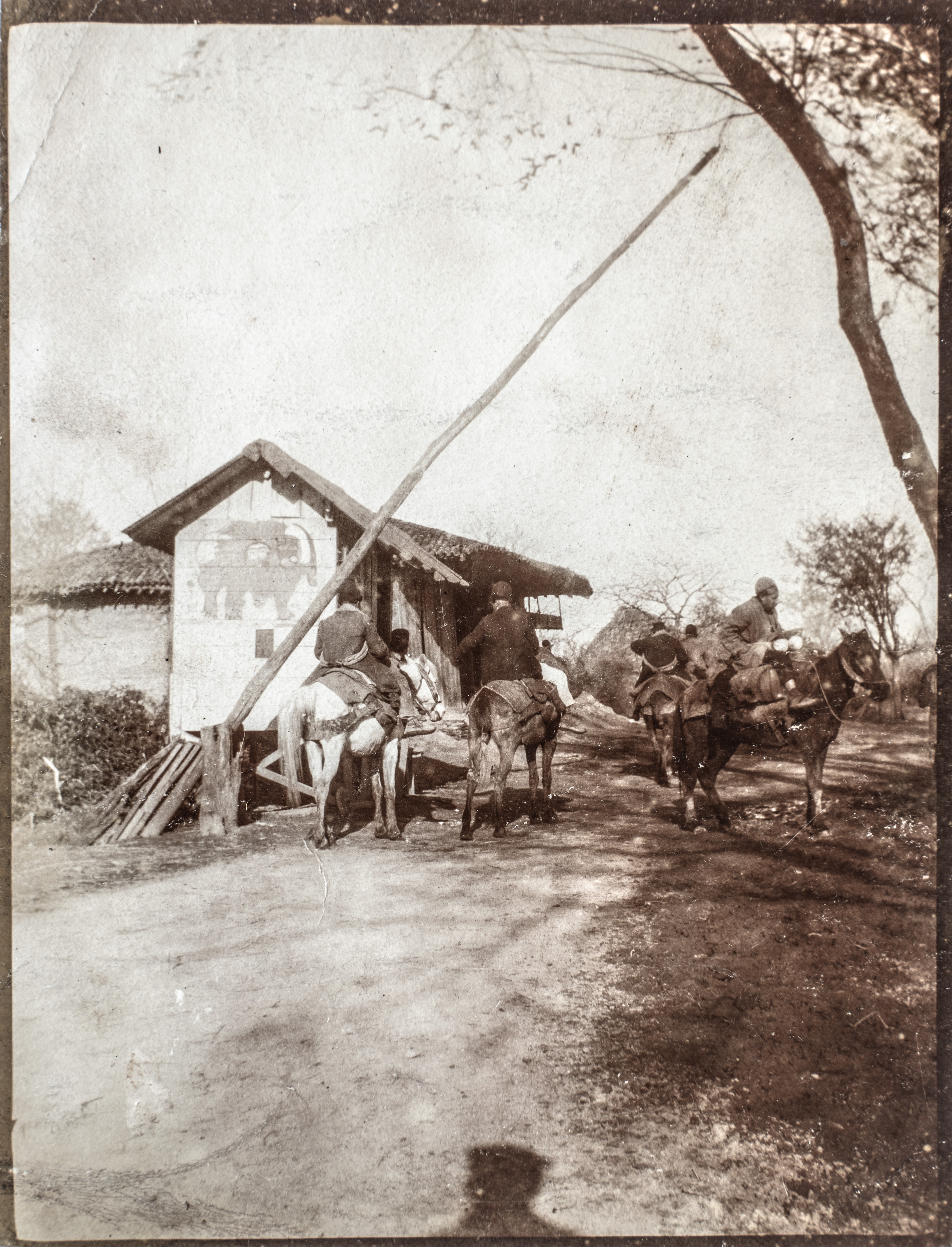
The next day we came to Enseli in Persia. We got our wounded into some buildings and were very busy for two or three days dressing wounds and amputating limbs. The four nurses were all volunteers from Baku. When the wounded had been sorted out and distributed among various hospitals, I was sent to Karvine with another girl, an Armenian. The other two were left at Enseli. At Karvine most of the patients were suffering from a very bad form of influenza. I was put in the officers' hospital. Two patients were very bad and I nursed them day and night with the help of orderlies, but both died. There was a great difference between working in hospitals and in the field. In the field I had dressed their wounds and sent them on to the hospital, so I never saw them again. Here I got to know my patients and it was very hard to lose them. Until before the Baku killing I had never seen anyone die. It was Capt. Allan and Capt. Rutherford that I nursed till their death. Capt. Rutherford's mother wrote to me from New Zealand a very kind letter of thanks, and asked me if she could do anything for me. It was very generous of her, I wish I could have saved her son for her - that would have been a great reward! I was very young and inexperienced but I tried hard to help my patients and if I did give them pain, they were very kind and tried not to show it. They were all very good to me.
The doctors too, were wonderful. They worked hard, but they never minded if I asked them to explain anything I did not understand. My English then was even worse than it is now. Colonel Burke was in charge of the 40th Field Hospital and Major Glen was in charge of the officers section in which I was working. They were both the best type of doctor, I am certain that their patients agree with me.
On the 11th of Nov. our orderlies came banging on the door, cheering, and shouting that the war was over. We were frightened and thought that they were drunk, though that had never happened before. We barricaded the doors and told them to go away, and the next morning I reported to Major Glen that some of the orderlies had been drunk, and told him what had happened. To my surprise he started to laugh, and could not stop. I could not understand such behaviour because he was a most serious man. Then he told me that the war was really over. It was hard to believe but I knew he would not joke about that. The war seemed to have gone on and on, ever since I could remember, and it seemed incredible that everything would be normal again. Then I went to my quarters and suddenly realised that we Russians could have no part in this rejoicing. That we had sacrificed so much and nothing would be the same again for us. That was a bitter moment. We had died, we had starved and we had no reward. Those little mounds all over Poland, Austria and Russia! I knew many of the men who lay in those little mounds. They lost their lives. They may be at peace, but their living comrades still have no peace and no glory of victory!
I must stop. It is too painful for me because I have met some of those that live. They are fighting an inglorious battle for existence all over the world! I stayed working in Karvine hospital until January 1919, by which time most of my patients were either better, had been sent home for special treatment, or were demobilised. Of the five Russian sisters in the Hospital four were the properly trained ones left from General Baratof's Russian army. One of them was working in the same Field hospital as her husband, who was a doctor. One night they were attacked by Kurds and nearly all butchered. Her husband was killed but somehow she was left; she can't remember why, she must have fainted and they thought she was dead. Afterwards she walked two hundred miles till she got to the British army, completely exhausted. She was very ill for a long time. I nursed her. She was dazed for weeks, then she had a stillborn child and nearly died. I had to help Doctor Knox and a midwife. The midwife did not know English, so I had to act as interpreter. Slowly the sister got better, and in January the British gave her some money and she went to Tiflis and I don't know what happened to her after that.
We all received a very handsome reward and our passages paid to Baku. I also had a letter of thanks from the British headquarters for my work in their hospital.
I must say about Persia, and Qazvin in particular. Between Bandar Anzali and Rasht the country is very like England. There are the same flowers in the spring and the wooded hills look like parts of Surrey, but some of the fields are very wet and rice is grown in them.
They say there are a lot of snakes but I did not see any as I only passed through with the convoy in a Ford lorry. Enseli was really a European reservation for Lianosof, a Russian caviar company. British Officers who stayed there have sampled some of the best caviar in the world. The soldiers had it issued to them as part of their rations, but most of them did not like it and complained to the quartermaster that they did not want any of that "fishy jam" for their tea again. All the big boats came to Enseli. On the other side of the lagoon was the real Persian town 'Kasian' and it was a most interesting place, like all the Persian towns and bazaars. One can spend many hours going round a Persian bazaar and noone will hurry you into buying anything. The merchants sit with their riches like china Buddhas, smoking their pipes and looking in front of them, and you can admire all their things in peace. If you do select anything it takes a long time to get him interested; he will just throw his head up and say 'Yoch!'
In Karvin, it took me a whole two weeks to buy a samovar. I used to go with any boy or sometimes with my future husband and we haggled with a merchant for a while, then went away and came again when we had nothing else to do. Kasian is different from the other inland towns. There were many Armenians living there. The finest thing that I saw in Kasian was a garden belonging to a Persian Prince. An Armenian sister from the hospital knew somebody who knew the prince and so she got a permit for us to visit one Sunday morning. It was a wonderful botanical garden covering many acres and I should imagine he had specimens of nearly every plant. I did not know much about tropical trees and plants then, but I should like to see it now, when I could take a more intelligent interest in it.
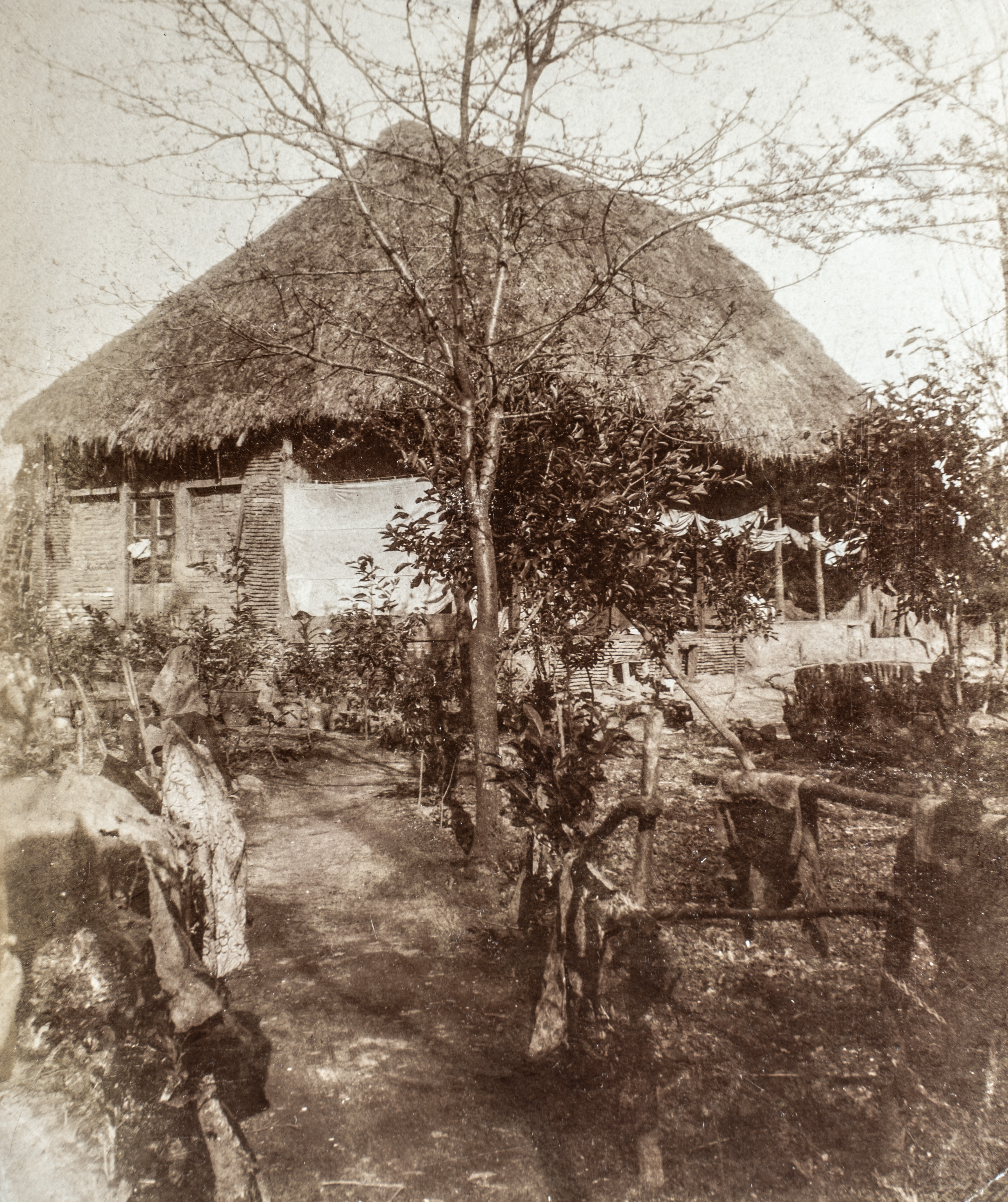
The Caspian sea teems with fish of all kinds, chiefly sturgeon whose roe is made into caviar, and there are cormorants and flamingoes. Rasht is a pretty place. All round the town on the very old bridle path are many beautiful old arched bridges, the path was a road hundreds of years ago and I loved to ride on horseback there when I went to stay for Easter after I moved to Baku. There was an American School and Mission at Rasht, also a British consul and the bank. In Persia the English are in charge of the Bank, the Belgians of the customs, the Russians of the roads, and the Americans of the schools. The Russian road company was a fine organisation. The roads in a mountainous country like that must have been most difficult to construct and were well made and well kept. Their headquarters were at Karvin and all the hospital buildings that the British used belonged to this road company. The officers' hospital in which I worked was a beautiful Russian club house for the road officials. These officials were still waiting for the orders to come which never came, and as nobody paid them, they just lived on their savings. Their doctor died of typhus while I was there and Major Glen attended to him. I used to prepare invalid food for him but I was not allowed to nurse him. When we were waiting at Enseli for our boat Kursk to come, I met my husband at a tea party given by the officers' mess. As he does not know I am writing this book I had better not say anything of our romance. He is a very reserved Britisher and you know what that means.
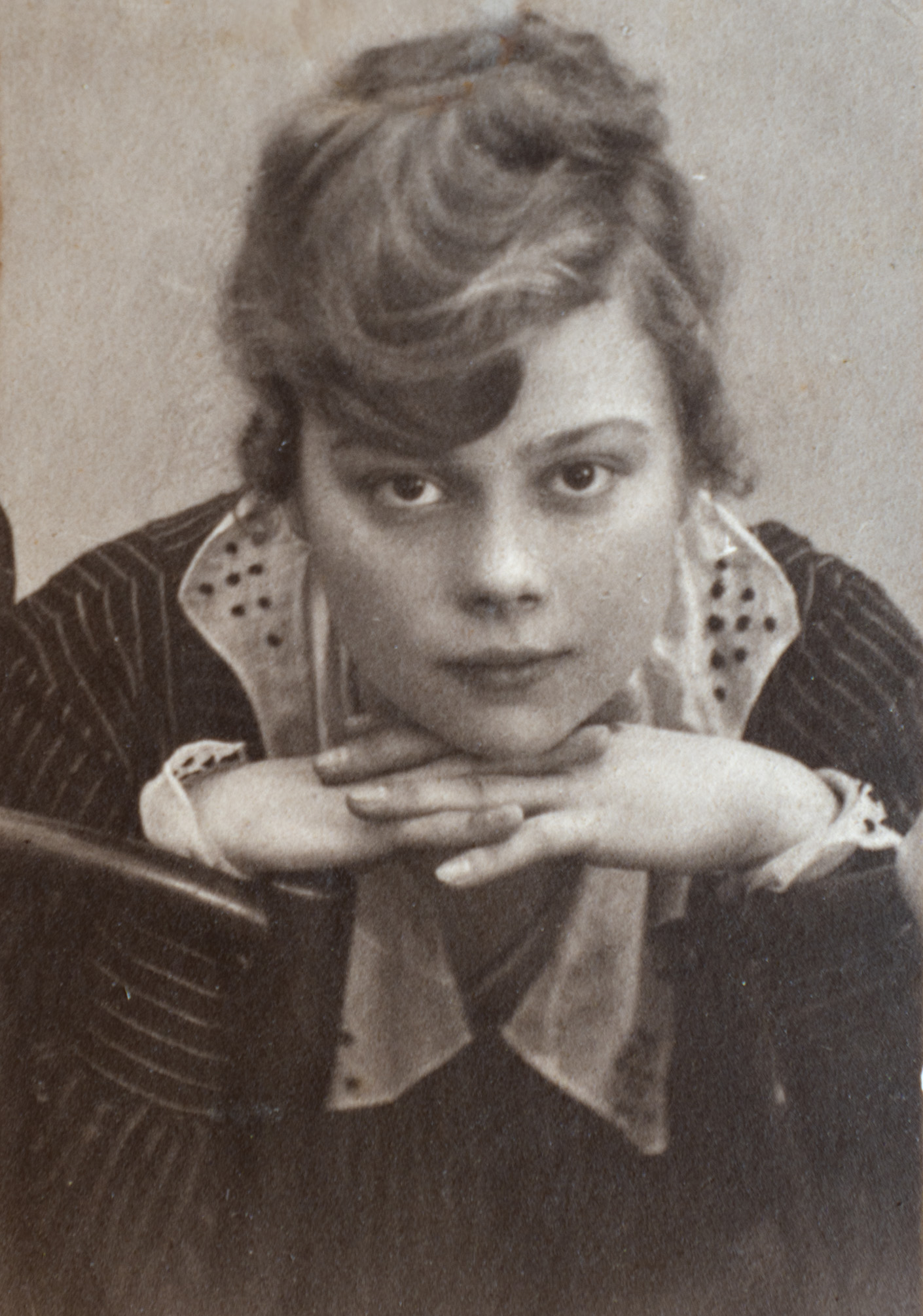
I got back to Baku and my friends, as always, were very pleased to see me and made me welcome. They had suffered two losses in the family since I left them. Their old grandfather had been very roughly treated by the Turks when they came looting. They wanted his watch, which had been presented to him by the governor of Baku for his services to the town, and he asked them to leave it to him. They struck him and also were about to cut off his finger with his wedding ring, because they could not be bothered to take it off. But his poor old wife ran and got some soap and persuaded the Turks to let her remove it. Unfortunately the old gentleman collapsed and died soon after the Turks had gone. They had also lost their niece Tamara who had been staying with her other uncle in the town. She went out one day when the Turks were in Baku, and she never returned and has not been heard of since. After the Turks had gone they advertised in the Baku papers for information, but none came. When I had a letter from them in 1924 they still did not know her fate; they fear she was taken alive by the army. Poor Tamara! She was only sixteen, and very beautiful. I have her photograph, and she looks at me with her big brown eyes.
The food in Baku was scarce but not as bad as it had been, because the British had come back and taken charge of the town. Anyone who worked for the British received a ration, so many of the people got employment with them.
I got a post in the Marine Department as a clerk interpreter. Commander Dogerty was my boss, and he was a very patient man. There were two of us in his office and the rustle of our dictionaries must have got on his nerves, because he used to go out with a look of murder in his eyes. We knew very few of the technical words in the papers that we had to translate, so we just picked up words from the dictionary and tried to convey something of the meaning to him. Now and then we used to get a fit of the giggles, and it was painful to us to restrain ourselves. Honestly we should have given up the job, because we were not fit for it. But it meant food for the family, and perhaps he knew it too, so many of the papers were translated by gesticulation and he put them into English.
My fiance managed to get a trip to Baku. He brought some hundreds of millions of roubles to the army bank of Baku. He was told to check them but of course he did not as it would have taken several days to do so. During the three or four days while they were being counted at the treasury of the bank we explored Baku. I took him to the Russian cathedral and of course we went to the opera every night. The bank found there was a shortage of only 300 roubles (a matter of a few pounds). He paid it cheerfully saying that it was worth it. We got engaged then.
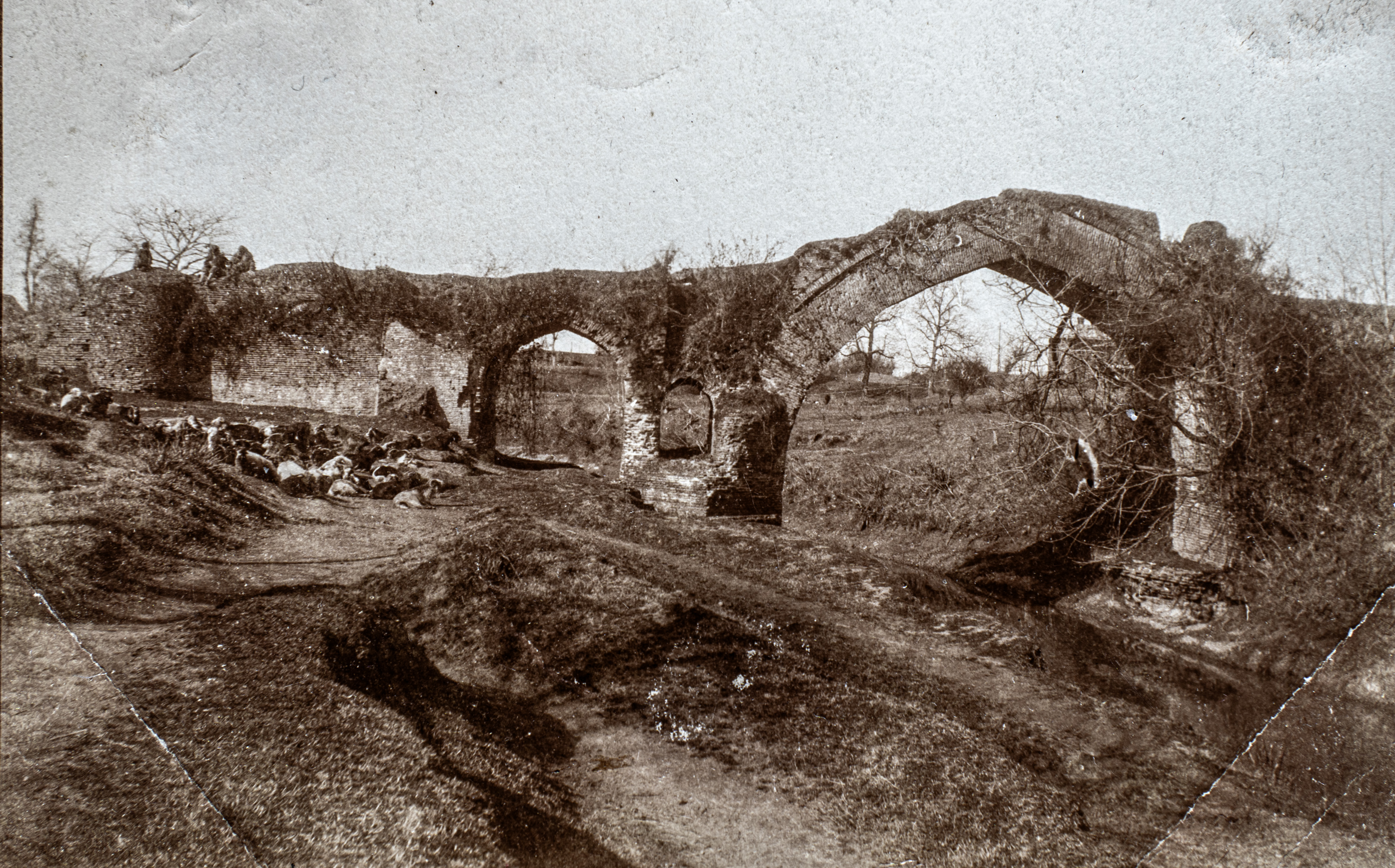
"The old bridge at Rasht where I rode."
At Easter the other girl from the office was going to some friends in Kasian and Rasht and offered to take me with her. In Rasht, my fiance used to bring round horses every day and we went riding. After four days in Rasht we went back to Baku and that morning my fiance gave a "Kron" to a gardener and he loaded a lorry with scented roses. On my arrival in Baku I had to hire two coolies to carry them, and I walked back at the head of a procession of starving people. Baku had not seen a sight like that for a long time and they all gazed at the flowers.
Persia is a country of roses and most beautiful grapes of many varieties. The grapes range from a very tiny "ladies fingers" variety that has no pips and is almost skinless, to a big red one that ripens in late autumn. The Persian farmers are extremely courteous people. In Karsin if I went for a walk or a ride anywhere near the vineyards they always brought me a basket of grapes, and insisted on sending a child to carry them home for me. I hope I did not abuse some custom of the country in my ignorance. I always used to give the child some "baksheesh". The Persians are a very likeable people, very honest and polite. There is no thieving, we never locked anything there. The punishment for thieving used to be very severe: the right hand being cut off. Consequently thieves were very rare.
The journey to Karsin was markedly different from the journey back. On the way up in September 1918 we had seen many starving refugees crawling along the road. They were a pathetic sight, dirty and sick. In every corner and sheltered spot we had seen thin and ragged corpses, but on the way back in 1919 the roads only had ordinary healthy traders with their wives and children riding on a bedstead balanced on the back of horses, donkeys or camels. The extraordinary thing about the Persians is that they are cruel to their domestic animals.
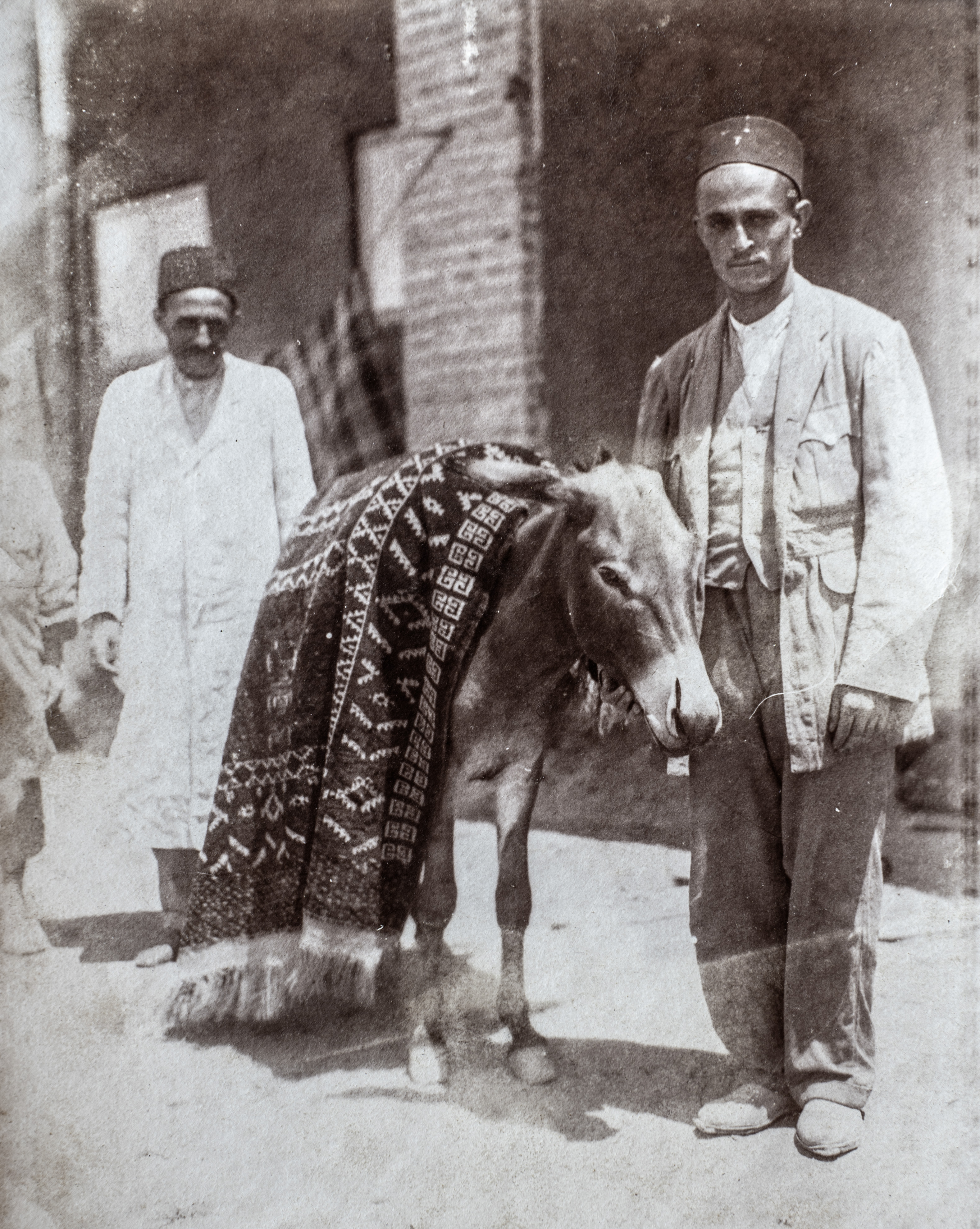
Many a time I have seen English soldiers beating a Persian for choking a donkey or horse with some cruel instrument. I hope they have by now learned from the Europeans to treat their animals kindly, because it was a depressing sight to see poor little saddle sore donkeys staggering under huge loads. Every garden of Eden has its poor donkey! It would have been better if God has given the animal some poisonous sting so that it could use it when it was being ill-treated. Which reminds me of an ungrateful donkey.
I was once blackberrying with a little boy called Bobby on a common, and there was a fat donkey tied up nearby. It had eaten the grass all round as far as the rope would allow, and was looking miserably at the lovely grass beyond its reach. I said to Bobby, 'Poor little donkey, go and tie him up in a new place.' I went on picking blackberries till I heard Bobby shrieking, when turning round, I saw the ungrateful beast shaking poor Bobby by his coat as if he was a bad carrot. I got a stick and freed Bobby from the wretched donkey, and then finding that no serious damage had been done to the boy I rolled on the grass with laughter. It was really funny, and Bobby said, 'Next time you go and do it yourself, then you won't laugh so much afterwards.' There is no moral to this story but I just remembered that it happened.