Chapter 6: Africa!
I sailed in September 1927. It was a very interesting journey to me, and I enjoyed it greatly, though I did not think I would. At the start of the voyage the people looked very unfriendly and old to me, and I sat in the lounge studying my fellow passengers. Also, I still had a pain in my heart about leaving Helen. But later on, when a few women talked to me, I found out that I was not the only woman who had left a child; some of them had left several behind. So that comforted me a little, and the passengers, when I got to know them a little, were not as unfriendly as they had seemed. It was just a habit that they had developed in Africa; they did it to discourage people they didn't like from talking to them. We had a jolly voyage; there were a lot of competitive deck sports and games, and dancing at night. As I did not know anybody, they were all very friendly to me, and several women I met then I can still call my friends. We had a very interesting man, Father Hueson, an American missionary, going to Monrovia. He wrote a book about that trip and about his journey to the Gold Coast on foot. There was an American girl coming out to be married at Monrovia, and Father Hueson married them as soon as we arrived there. The girl's fiancé was with the Rubber Plantation Company. She had lovely dresses and danced very well.
There was a man from the Daily Mail, and we were terribly thrilled thinking that we should be all over the front page of the papers, but he was going to Liberia to study the slavery question there, and only wrote a short article about the trip. I was only mentioned as a "charming Russian lady adding a cosmopolitan touch." I was talking one day to a lady who was going to the same place as I was, and she asked me if my husband had ever mentioned anybody in Port Harcourt.
I said, "Yes, he knows a lot of people," and I told her the names. She asked whether he had mentioned her husband, and I said, "No, I don't think so."
She told me, "Everybody knows him, as you will soon find out when you get there; he is a very senior man."
I thought, no doubt I shall, if you are there. But she liked me and was very kind to us all the time she was out.
The first call we made after leaving Liverpool was Bathurst, Gambia. It looked flat and uninteresting. The next call was Madeira, where I did not go ashore, but from the boat it was beautiful. The sea was bright blue, reflecting the deep blue sky, and the hill in front of us was dotted with pretty villas and gardens. Since then I have landed there many times, and each time I think it more beautiful. We often go ashore and wander through the quiet streets, cobbled and moss-covered, with pretty, brightly shuttered houses on each side. The town garden is lovely; masses of flowers, both tropical and others. There are hedges of hydrangeas, plumbago, and other lovely flowers. The tourists go to the top of the cliffs by motor to "Reid's Hotel," where they bathe and take breakfast or lunch. Once we tobogganed down from there on sledges over the narrow cobbled streets. In the markets, however, the flies are a pest.
One of the first ports of call on the West Coast is Sierra Leone. From where we anchor in the harbour, the town looks charming, climbing up the hills. Although I had not been ashore, I knew it was very hot by the look of the people when they returned from an excursion. There are several shipwrecks lying in the harbour to show what happens to a boat if she goes too close inshore. Next we anchored at Sekondi-Takoradi; I did not go ashore as it was too hot. Many people landed there — some government officials and a lot of gold miners. Punch once published an article describing the people that go to the West Coast of Africa: "The Nigerian officials wear a green cummerbund, and the Gold Coast officials wear a yellow one, and the Gold Coast passengers are allowed to stand a drink to the Nigerian ones; those going to the Gambia one never meets — they exist but one never sees them."
After Sekondi-Takoradi, our number was very much reduced. The next day we were sailing close to the land. At that distance it looked most inviting, with lovely yellow sandy beaches, palms, and other green trees, but not a roof of a house anywhere. I asked some of the passengers why no one lived in a lovely place like that. I expected it to be dotted with pretty bungalows.
They laughed at me and said, "Wait till you get on the coast; then you will know."
I know now because it is not a European country and never will be. We can never make a home here and bring our children with us, though recently some people have been trying to prove that it is possible. As a result, we see a few European children, pale and listless, or neurotically excited.
We got to Accra the next day, and the passengers had to be lowered in a "Mammy Chair" from the steamer onto small surf boats. These were skilfully paddled by Kroo boys with funny three-pronged paddles like Neptune's trident. The surf was very strong there, and the passengers going to Accra in these small boats were well shaken up by the waves before they reached the shore.
The next morning we got to Lagos. Several husbands came to meet their wives; they paid the latter's various onboard bills and tipped the stewards and stewardess that one had not seen throughout the voyage, and took them away to various places ashore. The voyage from Liverpool to Lagos takes fourteen days; I had another two days on the boat before we were due at Port Harcourt. I went ashore in Lagos with some people; we visited the Cold Storage Company and had ice creams and walked along the marina. The main street of Lagos runs alongside the Lagoon, and I was pleasantly surprised that the houses were good, the gardens lovely and dazzlingly bright, with bougainvilleas, hibiscus, flame of the forest, pride of Barbados, and other plants that grow like weeds, and whose colours delight the newcomer's eye. It was not as hot as in Mesopotamia in the summer, but it was more exhausting. After lunch I went to bed, which was very unusual for me, as I had never before wanted to rest in the afternoon. There were very few of us left on the boat after Lagos, but we had a very good concert that evening, as there were some quite good musicians and singers among our few passengers. It was a very pleasant evening.
Some of our passengers asked me if my husband had a good house.
I said, "Yes, he says that it is quite good; it is raised up on pillars eight feet high, which makes it cooler."
hey said they were surprised that a man should expect his wife to live in a house only eight feet high, as leopards could easily jump through the window. So when that evening my husband was showing me round the garden, he asked me if I liked the house; I looked at it once or twice, and it certainly looked as if a leopard could very easily hop into it.
I said, "It looks quite nice, but is it safe?"
He was rather surprised to hear me say that and said that it was quite safe.
I said, "Don't the leopards jump through the window sometimes?" He laughed with relief, I thought, and told me that they had evidently been pulling my leg on the boat. But the next morning there was a lot of hammering going on under the house, and I asked him what it was.
He said, "There are some carpenters doing small repairs."
That morning, when I was having a bath, I heard them hammering right under the bathroom floor. When I got out of the bath, I nearly fell down under the house as there was no floor; they had taken the boards away while I was having my bath.
The journey between Lagos and Port Harcourt does not provide much variety. At first we were at sea; then on the second day we were going through wide creeks with swamp on both sides — just black mud and a tangle of mangroves everywhere. Mangroves grow just anyhow: branches grow up, then drop long arms into the mud and grow again; I believe if mangroves were planted upside down, they would grow just the same. Sometimes you see natives fishing in their dugout canoes. We saw a few villages with tiny mud huts on small dry patches of land. What I saw on each side of the boat was more like a nightmare than reality. I thought how dreadful it would be to be stranded in a place like that. When we got in sight of Port Harcourt, we saw a pilot boat, and my husband was on it; other wives also recognised their husbands.
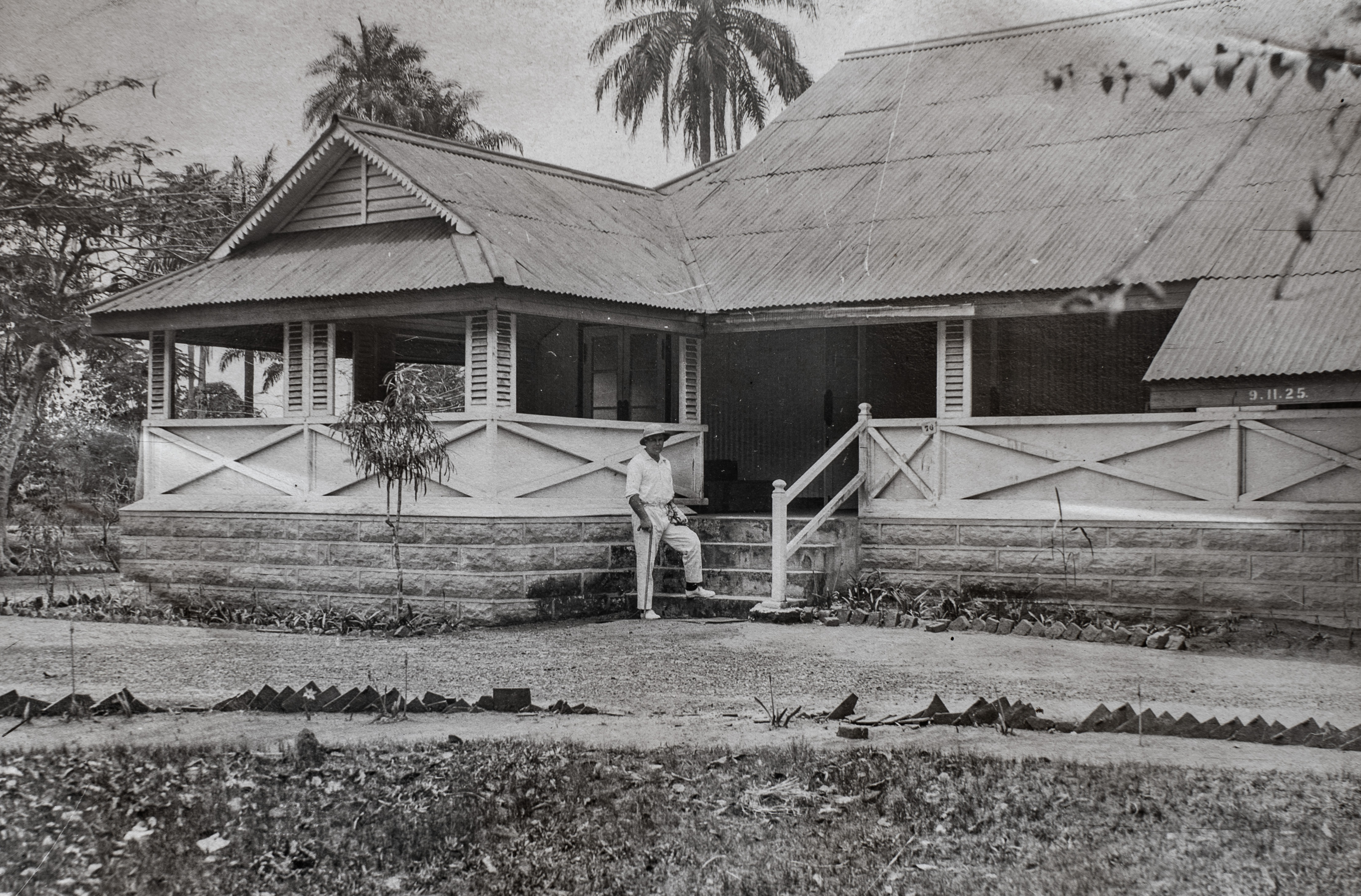
Port Harcourt is built on a small bluff in the swamp. It is very neat and tidy; the roads and the compound drives were made of red laterite. I thought it was very gay-looking, and the houses were nice. It started its existence in 1914 when a few men were sent to build a railway. They lived in tents at first, then corrugated iron huts. They had to live on tinned food, as there were no villages to supply chickens and eggs as in most places. The few natives that lived nearby were very primitive and shy. They were the people that had been harassed by slave traders; they had been forced to retreat more and more into the swamps and live as best they could. They are Ibo, and the hardship of their lives has made them a sturdy people with great powers of endurance. Most of the railway gangs all over Nigeria are still Ibo people; they mix well with other tribes and learn their language and their ways. When there is an emergency job in a case of derailment or a washout in the rainy season, they can work very hard and for long spells. Port Harcourt was a railway headquarters for the Eastern division of the Nigerian Railway, and most of the Europeans there were railway officials.
There was a resident Assistant District Officer in the political department. The Resident and his wife at that time were a charming couple and were very good to the juniors; they often had what they called children's parties. There were two banks: the British West Africa and Barclays. Barclays was building new premises, and soon after I arrived, they had an official opening to which many of us were invited. We all arrived at 5 o'clock, and the Resident opened the bank with a golden key and made a very good speech. For a little while, we all stood about, not knowing what to do next. Then two dogs started a fight; they were just like a dust storm, rolling at terrific speed through the compound. That broke the ice, and in a moment, we were all chatting gaily and laughing. Soon, refreshments were brought, and we had a very pleasant evening. Few cars were to be seen in Port Harcourt, and most people walked everywhere. There was only one road around the circle, and in the evening, everybody who was not playing games used to walk around the circle. There was a courting couple at that time, a nursing sister and a railway man, and I was sorry for them as there was absolutely nowhere to be private; they were always overlooked. She lived in the sister's quarters with some other sisters, and when they went for a ride, they could only go round and round the 3-mile circle, with houses on each side, and meeting other cars all the time; the engagement was broken later, by mutual consent, I think.
I think there were about one hundred and fifty Europeans in Port Harcourt at the time. The atmosphere was very friendly. We had jolly parties and club dances, with the band from the Elder Dempster's boats that came once a month. My husband and I did not give many parties because, in one of the books that we had read about Nigeria, it said, "Take crockery for two people because you may get someone on spec whom you will have to put up." It did not sound very jolly. My husband, however, had taken enough for four, so we often used to have a couple over for bridge. But no one expected us to give parties on a first tour, and we were asked everywhere. My husband's chief's wife was very good to me. She was a very capable woman, and whatever she did, she did it well. A domineering woman, who some people did not like, but she did not boss me and was very helpful. I was always grateful to her for showing me the way of the country. It is nice to know a woman who is not a fool. I am afraid women deteriorate much more rapidly in Nigeria than the men, mentally and physically; only rarely does one find a woman whom the country has improved, and that one is usually a missionary.
The missionaries get very tired at the end of their tour of two or two and a half years, but they are happier and more content than the other women. They have not got the strain of a social life as the others do; they have no class distinction, and in many other ways, they have not the wear and tear that the wife of a government official or a trader has to endure. Sometimes, in a small station, people that have very little in common are thrown together, and this does not make for a happy social life. In a big station, one can get a circle of friends if one is there long enough. Wherever you go, people usually are very hospitable.
There is only one hotel in the whole of Nigeria in which Europeans can stay—that is "The Grand Hotel" in Lagos — and a few years ago there was not even that. So everybody gets "put up" and looked after by private individuals. Of course, there are rest houses, but one has to take food and all the kitchen utensils, as well as bedding, cutlery, and crockery; in fact, everything one requires except furniture. During the first three months in Port Harcourt, I was very fit and enjoyed my life. A few days after my arrival, we went "on line" in a railway coach. The labourers came and fetched our things at about four in the afternoon. All the morning I was packing my belongings and some stores, and the steward boy was packing my husband's things and the rest. After we had sent everything away and had closed up the house, we went to the club for a game of golf. We got back to the coach about 8 o'clock and found that the whole place was full of smoke from the kitchen fire. I was told that it was a bad chimney and nothing could be done about it. The boys told me that all coaches are like that; the fire always smokes. So I told them that mine was not going to smoke and that it was going to stop immediately. First, I made them throw the fire out of the window, climb on top of the coach, and with a palm branch clean the chimney; then I made them take the range to pieces and clean the flues. When all this had been done, the fire was relit, and we had dinner at 10 p.m. and a smoke-free coach for the rest of the tour.
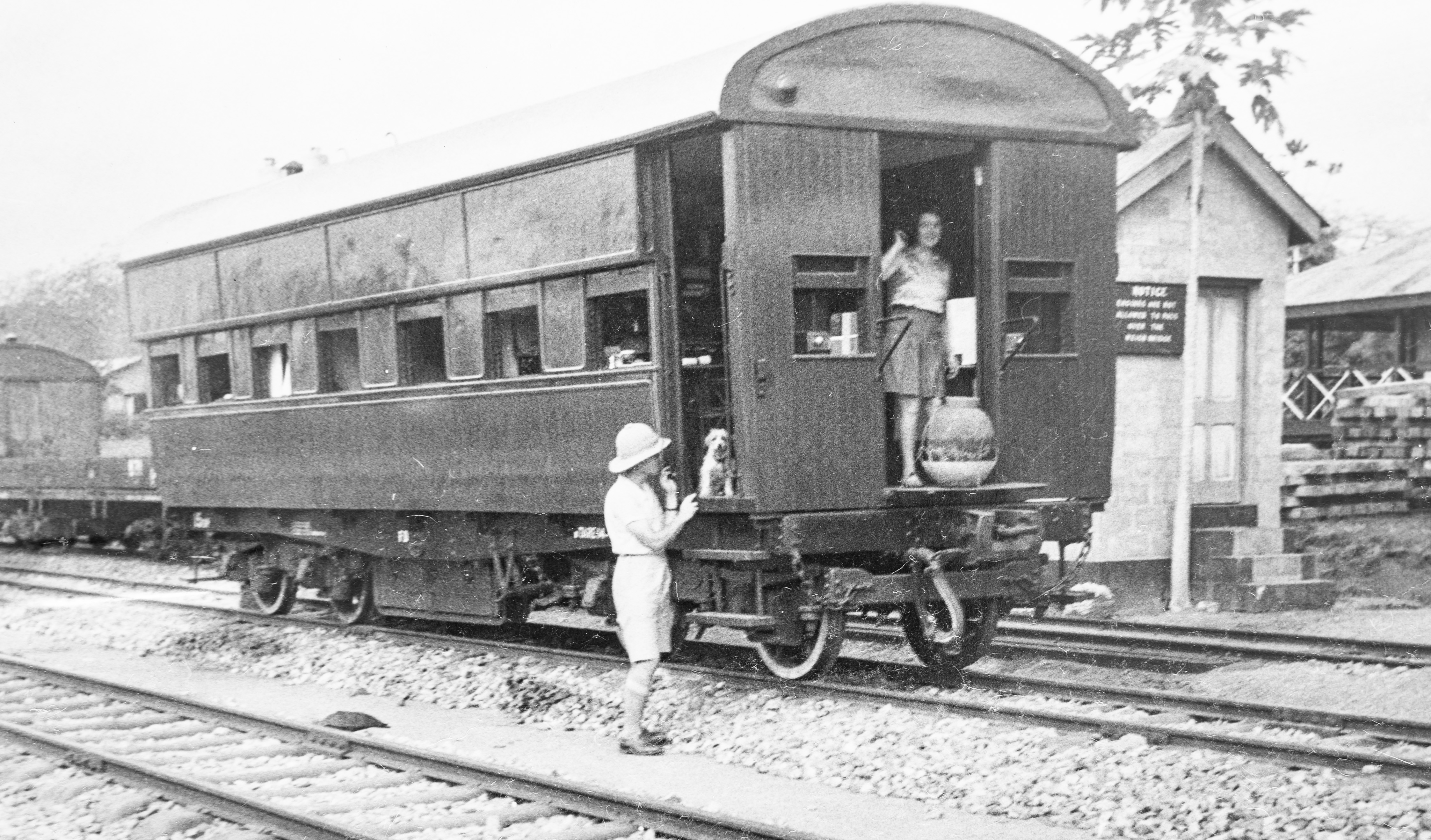
It was a very old coach painted pea green. It had one room for sleeping, eating, and living, as well as a bathroom and a kitchen. Both kitchen and bathroom were very hot; the water was in a tank over the bathroom and used to get so hot that one could not have a bath in it until it had cooled in the evening. My husband's cook was very old and cooked dreadfully. His custard was always yellowish-grey, the same as our bathroom paint. I began to teach him a few edible things, but improvement was very slow, and he began to look more and more worried.
One day he came and said to my husband, "Master, I no fit to stay with you again; Missis come and spoil things for me. I don't know which day be custard day, which day be rice pudding; she teach me too many things."
It was true that during the first week we had custard and rice pudding on alternate days. I did not do anything about it because I wanted to see what kind of a show my husband could endure.
It was rather amusing, but I could not stand it any longer and began to preserve our life. I had my first new cook of many during the next nine and a half years. This first one came from a man we knew who was going home. We dined with him several times, and I had remarked what a good cook he had. He said that I could employ the cook while he was at home; by the time he returned, we should be going on leave, so I took his offer gladly. My new cook did not look very bright. When he came back from the market, he gave me a lot of change — more than half of what I had given him. I thought he had not bought the things I had ordered, but he had, and everything was very good. I was astonished and realised that the other cook must have been robbing me right and left. But when breakfast was served, it was all one: kippers, bacon, eggs, all in one dish and very badly cooked.
I could not understand it and said, "You were cooking for your other master well; why do you cook badly for me?"
He replied, "Other master's steward was cook; I watch fire and clean pans."
So I realised that, as our friend was a little liverish and was difficult with his cooks, his steward boy (who had been with him for some time) had engaged a dummy cook, did the cooking himself, and pocketed the difference in wages, keeping everybody happy. I came to the conclusion that one is better off with a rogue than with a fool. One's nerves in this country get very frayed, and after a few years of battling to keep everything clean and moderately well looked after, one loses all sense of humour.
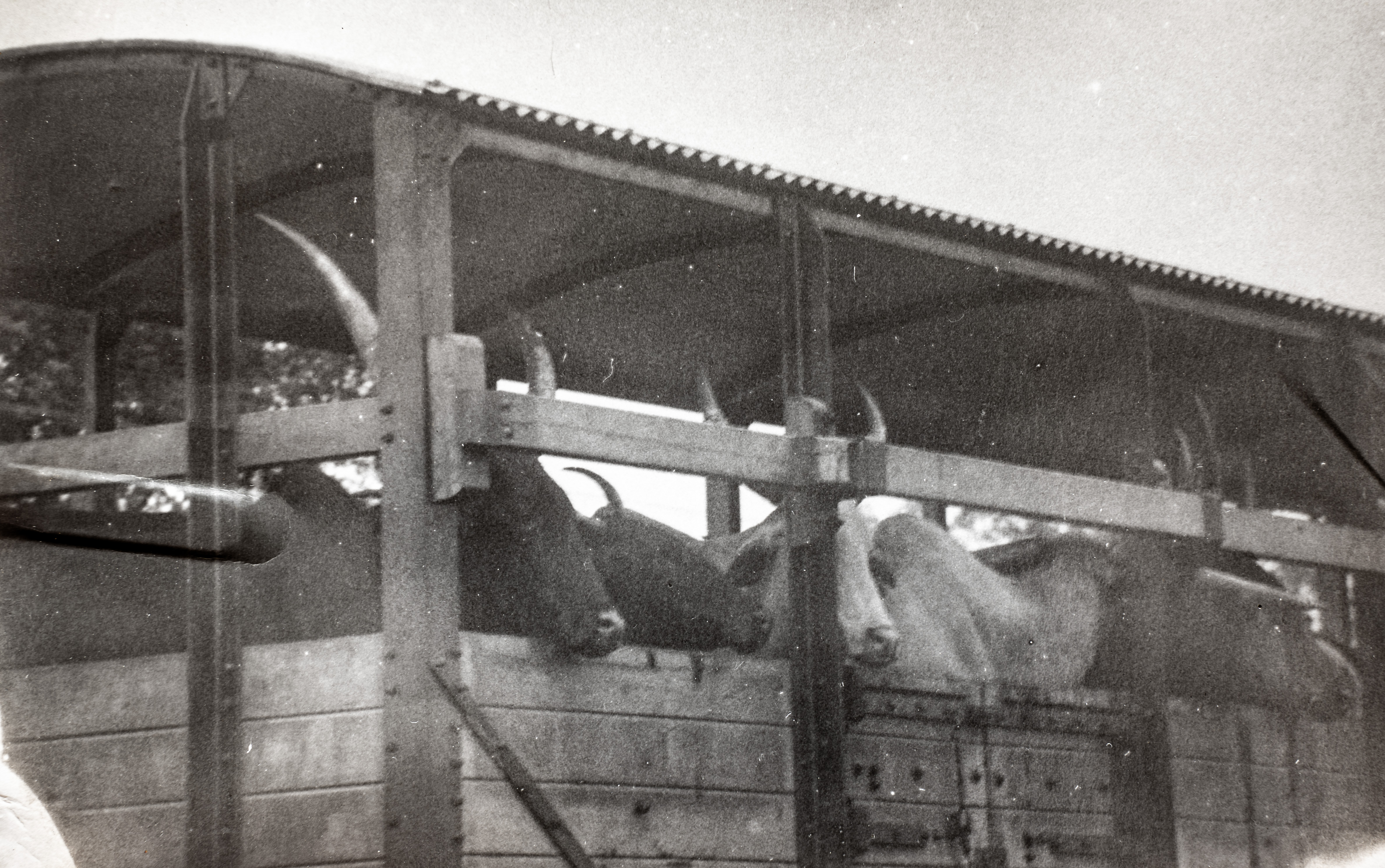
The section of railway line my husband was responsible for went as far as Otampa, about 120 miles up-country. The country as far as Umuahia (75 miles from Port Harcourt) is flat with forest and bush on each side of the line. There are few villages, and where there is a village of any size, there is a railway station and one or two sheds belonging to trading firms. These firms stock the few things that natives require and store palm oil and palm kernels ready for shipment to Port Harcourt and then England and other countries. 1927 was the last of the "Boon Years" in Nigeria; prices for produce were high, and all firms were eager to buy. I remember early in the morning there used to be a tremendous noise going on around each store. The native agents were trying to persuade other natives with pots and petrol tins full of oil on their heads to come and sell their oil. The price was agreed every day at headquarters and sent out to the agents; all the firms had to pay the same price for the produce, so that they could not compete, but they used to have various methods for getting the natives in.
One morning I would see a big crowd of natives around one canteen and fewer around the others. I found out afterwards that these firms provided the wood for heating the oil, which has to be done to make the oil run out of the containers. The other firms let the natives get their own wood for heating. Of course, after the natives had been walking all night with heavy head-loads of oil, they would naturally go to a place where the wood was already provided for them. Sometimes there was a kind of beauty competition, and the women got pieces of soap, which they promptly hid in their hair. One night, an agent set a lot of rat traps, and in the morning the rats were thrown to the crowd after the oil had been bought. The stampede after the fat rats was tremendous. Meat was very scarce in those parts because animals died of tsetse fly. The only animals that could be kept were goats and chickens. The few cattle that were brought down once a week by train went to the big towns, and that meat was too dear for the natives to buy. So anything with flesh that they could catch was greatly appreciated. Sometimes I was startled by shrieking and yelling crowds of natives rushing about excitedly and found out it was all about a mouse, a rabbit, or rat that they were chasing.
Aba was the first big town on my husband's section. There were, I should say, about twenty Europeans: the District Officer and Assistant District Officer and their wives, the bank manager and his wife, the doctor and his wife, several managers of different trading firms and their assistants, and a traffic inspector. There was also a German trader and his wife and a motor transport firm that carried mail into the few towns that had roads. There was a small golf course where we used to play with some of the residents. There were good roads to walk on, so it was a very pleasant place to visit. One Sunday morning at Aba, I asked my cook if he could get any meat; he said that he would try, and I told him he would have to because there was nothing for dinner.
"If you can't get meat," I said, "we must have a chicken, but we would rather have meat."
We lived largely on chickens when we were on line. I had a box tied to the coach outside the kitchen where my chickens used to sleep at night. During the day they walked freely around the coach. Sometimes one of them would decide to lay an egg, so she would find an empty wagon somewhere in the station and retire there in privacy. Occasionally the wagon was hitched onto a train before she had finished, and my hen went for a long journey. Sometimes I even got them back when a conscientious native guard returned them — complete with egg! That night we had very nice tender chops—lamb, we thought. Some weeks after, I found out it was dog. They bring lots of dogs to the market at Aba, and natives have dog meat as a special treat (they are fat little dogs, looking more like goats). We never had any more chops at Aba.
The next place was Umuahia, where there were many Europeans, mostly managers of various trading firms and their assistants. At intervals, the District Officer used to come into the station for a few days to settle various "palavers" of the natives. The doctor used to come occasionally to collect his fees from the firms. Most firms used to pay monthly retaining fees, and all their employees were treated free. As it was a healthy station, he only had the fees to collect. The trading firms here were very busy buying produce. In 1927, there were a lot of firms, and each had a European manager, and some of them had assistants too; altogether there were about twelve European traders. In 1933, when I went to stay with friends at Umuahia, there was only one manager. Nearly all the firms had been merged into the United Africa Combine, and there was very little buying, but a lot more selling. Since I was first there, a government middle school has been built five miles out of Umuahia. This has increased the demand for, and consequently the supply of, European food and other necessities. Farmers all around were very busy supplying food for the college and the native labourers attached to the place. Roads had been made, and altogether the place had become much more civilised.
Obeki was next along the line and was only a bush station, and the natives were a little wild; I never liked to walk far away in the bush there, though it was very pretty hilly country. Following on was Uzuakoli; there was a Primitive Methodists mission and boys' school, which was very good. Mr. Williams was the principal, and he understood his pupils and trained them well; they were well educated, good sportsmen, and they had good principles of life. There were several European masters and a couple of medical missionaries, all making a very happy community. We had many pleasant evenings with them when the coach was there. The mission was about a mile away from the station, and at that time there was no road and only a footpath zigzagging around the roots of mahogany and other large trees. Mr. Williams had a motorcycle, and it was as exciting as dirt-track riding close to the station. There were some trading firms and several European agents who were not as fit and happy as the missionary upon the hill. The climate is not good, and also they all got on each other's nerves. They had a tennis court, but nobody played there. I always felt sorry for them; it was such a God-forsaken place at that time. I believe there are only two Europeans now, but a road has been made. It is not so stagnant as it used to be.
I had my first palm oil chop at Uzuakoli. It is a traditional West Coast weekend lunch dish. Originally it was made of monkey meat, but now it is usually made from a chicken. There are a lot of ingredients: the cook crushes a handful of egusi seeds (which resemble marrow seeds) with a bottle until they form a creamy, doughy paste, adds liberal quantities of palm oil (which makes a golden gravy), okra (ladies' fingers), mushrooms, prawns, capsicums, and fresh red peppers. All these are gently cooked in this golden gravy. When the palm oil chop is ready, one boy carries in a plate of fufu (yam flour mashed and beaten to a stiff shape) and hands it to the principal guest. She then smacks it with the serving spoon as many times as there are people round the table, and one extra for the cook, after which she may help herself. The other boy brings the palm oil chop with hard-boiled eggs on the top. The table is crowded with many accompanying dishes: several kinds of peppers, shredded fresh coconut, ground peanuts, oranges, pineapples, bananas fresh and fried, tomatoes, Bombay duck, garlic, onions, sardines, and in fact anything from the kitchen which is edible.
The old West Coasters used to make the chop very hot and peppery, and it was not a very pretty sight watching them eat it. Everyone has a very big soup plate. First, they sprinkle it with salt and a lot of pepper; then they help themselves to fufu and chop; then all the other things that are put out on the table, making a huge mountain on their plate. They then proceed to mix it all together, roll their sleeves up, and get down to it! Perspiration runs in streams off everybody. At my first palm oil chop lunch, everyone had two helpings, and some three, washing it down liberally with beer. Palm oil chop used to be served once a week, and I was told that it kept fever away. It has been proved that palm oil is very good food and rich in vitamins. The southern Nigerian natives (who have very little meat in their diet) keep fit because they consume a lot of palm oil. I like a palm oil chop if it is not too hot. My cook knows that and supplied plenty of peppers for the table but put very little into the cooking. I can't say I enjoyed my first chop very much, though I believe it was a good and expensive one.
We gathered at our host's house about 12:30 p.m. I was the only woman there, and I did not drink any alcohol. The rest drank beer, then gin and bitters till a quarter to four, and then the boy came in to say that the chop was served. I was more than ready for it. After chop, they had brandy or neat gin, which they said was necessary to settle the chop. I went to bed for an hour afterwards, but the men went for a bathe in a nearby pool. When it was cooler, I took the biggest boy in the compound and went to meet them, but when I got near the pool, I was told that they had not finished bathing, so I told the boy to go back, and I would wait for the men by myself. He would not go, so I asked what was the matter.
He said, "I no fit to go myself; the people are plenty bad; they go chop me."
I had taken him in order to protect me, but he looked upon me as his protector and would not go home by himself. So I let him wait and walk with us.
The Southern Nigerians are always frightened in a new place; I suppose they had reasons. Not so long ago, before the British brought them protection from each other, no native would wander out of his compound after dark. It remains the same except in big villages and towns.
One of the managers had a glass eye as a result of the war. He found it very useful to have a removable eye because if he wanted to go out of the shop, he could take out his eye and put it on his desk to watch the cash box. No one would dare to touch anything with powerful juju like that in the shop.
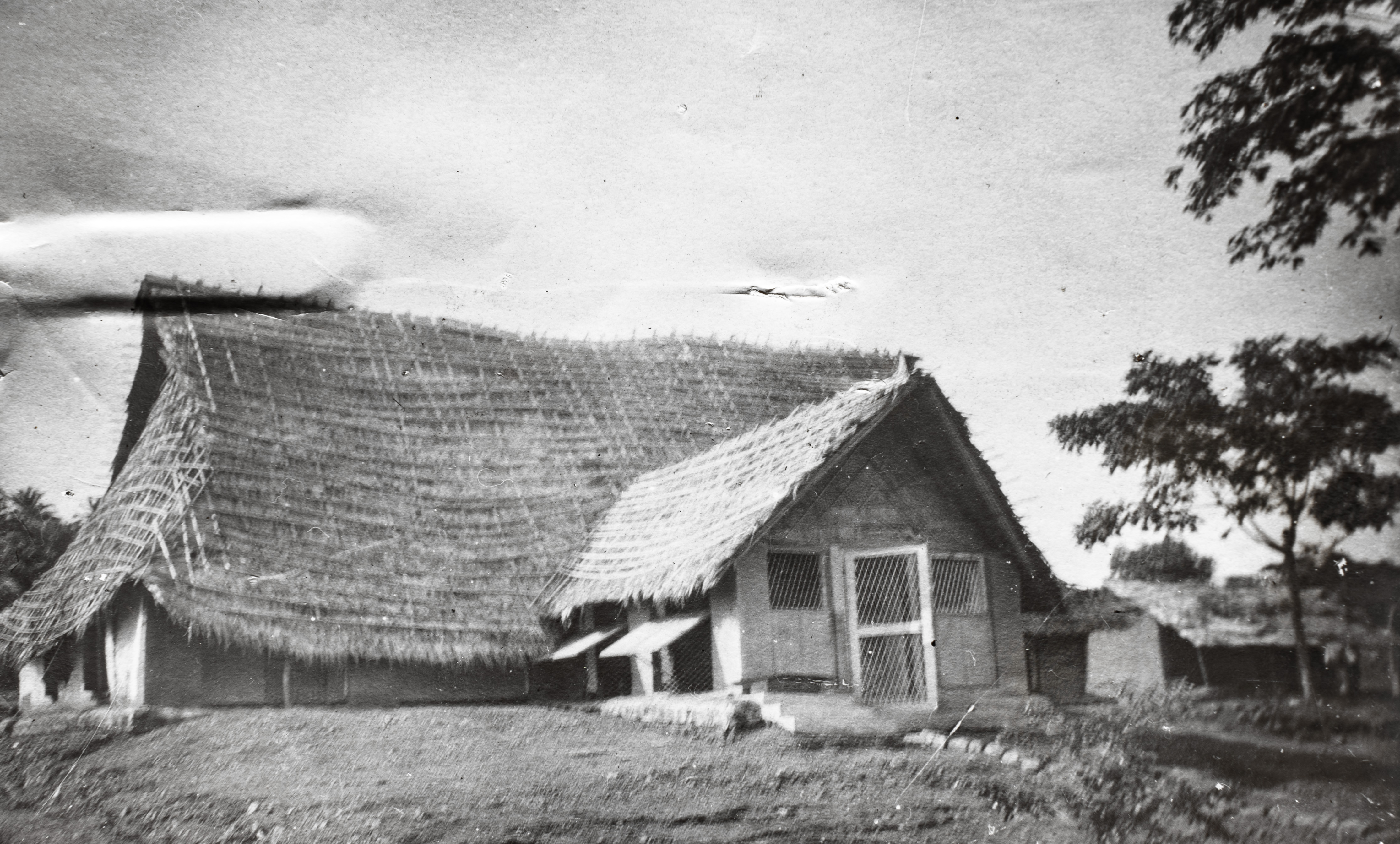
Ovim was next along the line, where we had a lovely big bush house where we used to stay a night or two every month. We had a beautiful view, as it was built on the top of a hill. There was a mission about a mile away across the railway on another hill. The missionary there was a very energetic man who did everything: building churches, trekking for miles mostly on foot, and doing simple medical work, such as dressing sores and cuts. If he was in the station when we arrived, he always used to send for us. We had many pleasant evenings, which were most interesting to us, as he knew the country and the people so well.
Oturukpu was ten miles away at the end of my husband's section. The natives there were not very pleasant, and I believe that they have not improved very much since we were there. One day I walked away from the station by a bush path and got to a small village. In the village, I saw a boy lying on the ground with a huge sore place on his stomach, looking just like a skeleton, he was so thin.
I asked the villagers if anybody could understand me, and one man came out from the crowd and said that he could, so I said, "I will give a note to a friend of mine, a missionary lady who has a hospital at Umuahia, and if he is taken there, she will treat him in the hospital."
I gave them the amount of the railway fare and put the money by the boy's side. When the man told the crowd what I had said, they all laughed and yelled; I asked him what they were laughing about. He said that they considered that they should have the money because they were well and strong, and that the boy was ill and "no good." Nobody wanted him, so why waste money on him? I then asked him to tell them that they were wrong: any one of them might fall ill, and if they didn't look after the boy now, nobody would look after them if they were ill. I told them he would get better in hospital, though I had my doubts about it — he had been too neglected.
They only laughed and said, "Anybody ill like that, he is no good; he die."
I was cross with them and told them they were to give him some food and take him to hospital, and then I went away. I had walked only a few yards when there was a scrum, and they all started to fight for the money, trampling over the poor boy. I went on; what could I do against the natural law — survival of the fittest — that had been their creed for centuries? It was hard to be so helpless. The government and missionaries have worked for many years, and it will be many more years before the natives' ideas and customs will alter. In times past, there was no medical knowledge, and the bad climate bred so many diseases that for self-preservation they feared sickness in their fellow men, and whether it was family, friend, or enemy, they wished for his death. They had the same attitude towards old people. One never saw a helpless old man or woman in the bush. As long as they could carry a load, they were safe, but when they grew too old to work in the field and carry a load on their head, nobody bothered with them, and they died. Also, there were no disabilities — people must have been helped to leave this world at an early age. For a long time, only the more civilised natives (those who had associated with Europeans) went for treatment in the hospitals. The bush people were too scared to go near them. Most of what I have said is still true of bush natives.
I remember at Ovim the medical missionary woman used to visit to give injections for yaws, a horrible skin disease from which most natives (even the babies) suffered. The missionaries used to let it be known through all the villages that they were giving free treatment to all sufferers. But the bush people were very frightened, so the mission demonstrated the treatment upon a few of their converts and upon the relatives of their own houseboys. One injection cured anyone who had contracted the disease recently, and three injections cured even the most neglected cases. When the bush people saw the result, they began to come in for treatment. The men took care to try it on their women and children first; then when they were cured, the brave men came forward. "Women and children first" held good in Africa as in Europe, but with a difference. It was the same with vaccination; when the natives found out that it was really a cure, without anything to pay and with no pain, they came in their hundreds.
I used to go and help the lady missionary when I was at Ovim. I broke the tops off the glass containers, disinfected and filled the syringe and she would give the patient a sudden smack — the shock would make him relax all the muscles which he had tightened, fearing the pain from the needle. In a trice she had injected him. She knew her people and treated them like children. Once we were mobbed. The assistant that was letting the patients in one by one had to go away for a moment, and the patients all thought it was an opportunity to try and be treated first. Immediately the hut was packed. Our table, the boxes with medicines, and we ourselves were pushed against the wall. The natives who pressed against us were all dirty and covered with sores. I did wish I could wake up from that ghastly nightmare! The boys rushed in and pushed them all out, and we breathed again. And I had a potassium permanganate bath soon after it.
When our train arrived at Umuahia, we used to go to the hospital to see our friends, the missionaries. It was a three-mile walk from the station, and as it was dark by seven o'clock, we always had one of our boys come with a lamp to light our return to the train. One evening there was a full moon, and we told the boy he need not come with the lamp.
The boy said, "Ah! Them white master say there be no moon this night."
I said the master had been joking with him, thinking that the European who had told him so must have been recovering from the weekend. But when we started on the way home, it became darker and darker, and the moon was not rising behind the palm trees as we expected; and we had to walk in the dark in the bush for three Nigerian miles, which for some reason felt twice as long as English miles. When we were nearly at the station, we saw a tiny crescent of moon appearing high up in the inky black sky. We heard afterwards that it had been a total eclipse.
I must say something about the pay trains because I got a lot of amusement and annoyance from them. The railway department found out that the only way to ensure that each native received his pay correctly was to send the pay train once a month with a native paymaster. The European foreman of each section travelled in the paymaster's carriage to the end of his own section: about 30 miles. At each station, the labourers and the headman were lined up, and as the European foreman called their names, they came forward and received their pay. The engineer went with the train on their section to see that everything was in order and also to inspect any work in the stations.
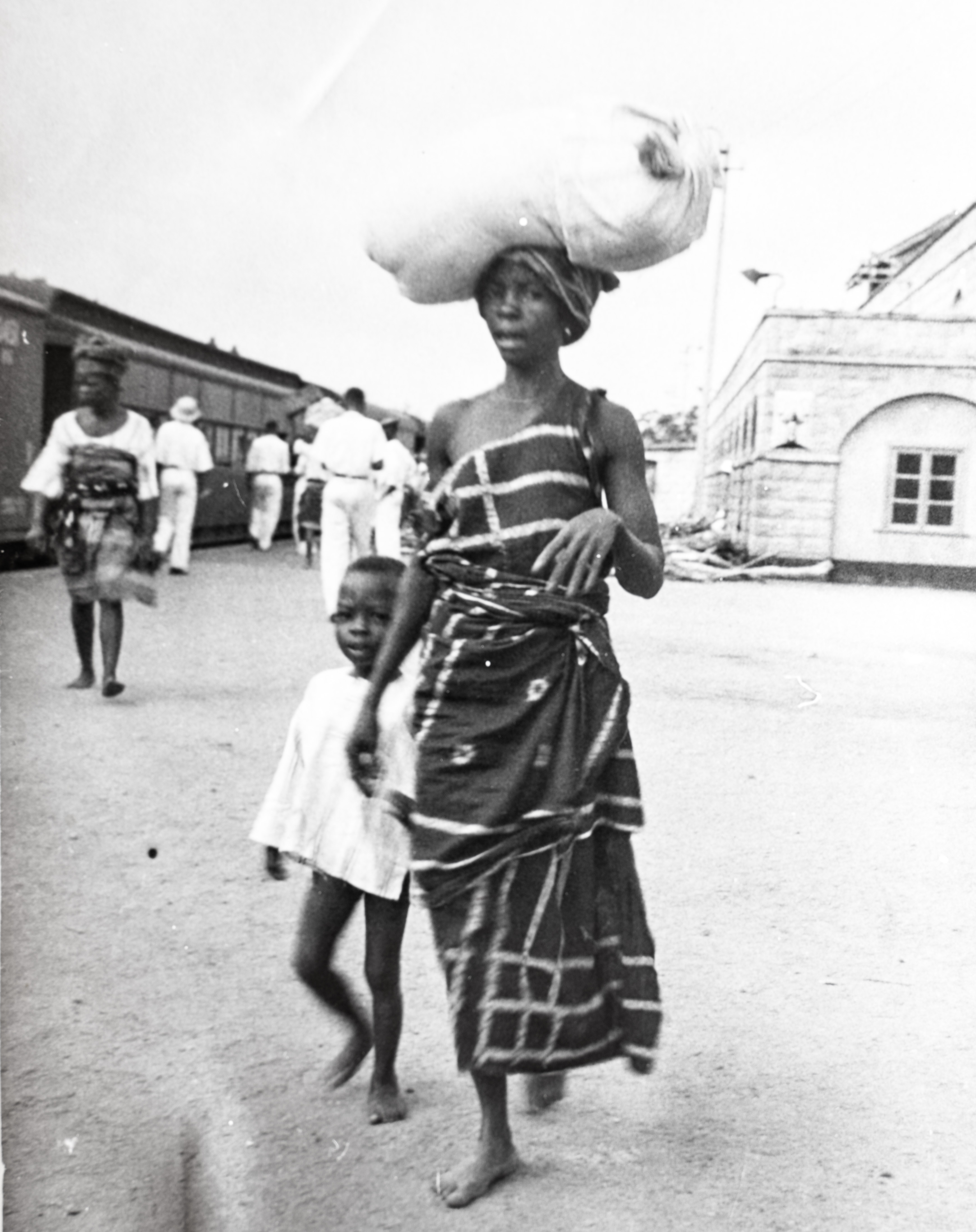
The train stopped for some time in each station while the pay was being handed out. All the labourers came in their best clothes; in fact, they put on everything they possessed. If a boy had two pairs of trousers and two shirts, he would put them both on. I once saw a capitalist, when it was 90 degrees in the shade, wearing trousers, two pairs of shorts, a thick woollen sweater, rubber coat, and a balaclava helmet — he was the envy of the whole gang. He must have been gambling successfully (they gamble a lot). The headdresses were the most spectacular. Some of the labourers were wearing wonderful creations that some ladies in the past had left behind. They were decorated with feathers, cherries, and indeed whole gardens. The railway gangs never bother about feeding themselves; they always have trading women supplying them with food, drink, and all other necessities. On pay day, if they are not quick enough to dodge the women, they have to pay up. The women are on the alert and usually take nearly all the men's wages, leaving them perhaps a little to gamble with. For the hard cases, the women would bring their husbands and all their relatives. If the man wouldn't listen to reason, they would use physical means!
One day, the pay train crowd was particularly boisterous. I was inside the hot coach, and they were screaming and yelling right outside my window. I opened a louvre to see what it was all about and saw a railway porter who was being fairly pulled to pieces. All his uniform with polished brass buttons and his smart cap were being torn to shreds; the women were like infuriated tigresses.
I fetched a mug of water, opened the coach door, made a very angry face, and threw the water over them, shouting, "Get out of here, all of you!"
It worked beautifully; the mob ran away, laughing and shaking the water off themselves. They forgot about the defaulter, and he, of course, was in his hut by that time, cleaning and tidying himself and thanking the gods (and me) for the escape. Until the next pay train, when I am sure he will pay up like a lamb. I had this with slight variations on pay train after pay train.
After I had been three months in Port Harcourt, I started to have a low fever; my temperature did not go up high, but it never went down to normal. I went on as best I could for nine months, till the end of my husband's tour. Meanwhile, the school where I had left Helen was not proving satisfactory, and my husband's family eventually took her away. She was too young to write to us, and I felt the separation acutely.