Chapter 14: A Scottish Tour
On our next leave in England, we hired a caravan and bought an old Sunbeam Twenty. The caravan had two rooms. In one there was a settee which pulled out at night and converted into a double bed, a wardrobe, a sink which served as a makeshift bath, and in the middle, a table that had a very annoying trick of collapsing every time we stood up after a meal. We quickly learned how to leave the dining table, but the first time it was disastrous and we lost nearly all of our crockery and glasses. The second room had another settee where Helen slept, an oil stove and a cupboard. I unpacked the clothes that we had brought and put them in drawers under the settees, hung the dresses and coats in the wardrobe, put the provisions into the cupboard, and locked the door, leaving the place very tidy and cosy-looking. We got into the car and cheerfully started on our journey while the owner of the caravan gaily waved us farewell.
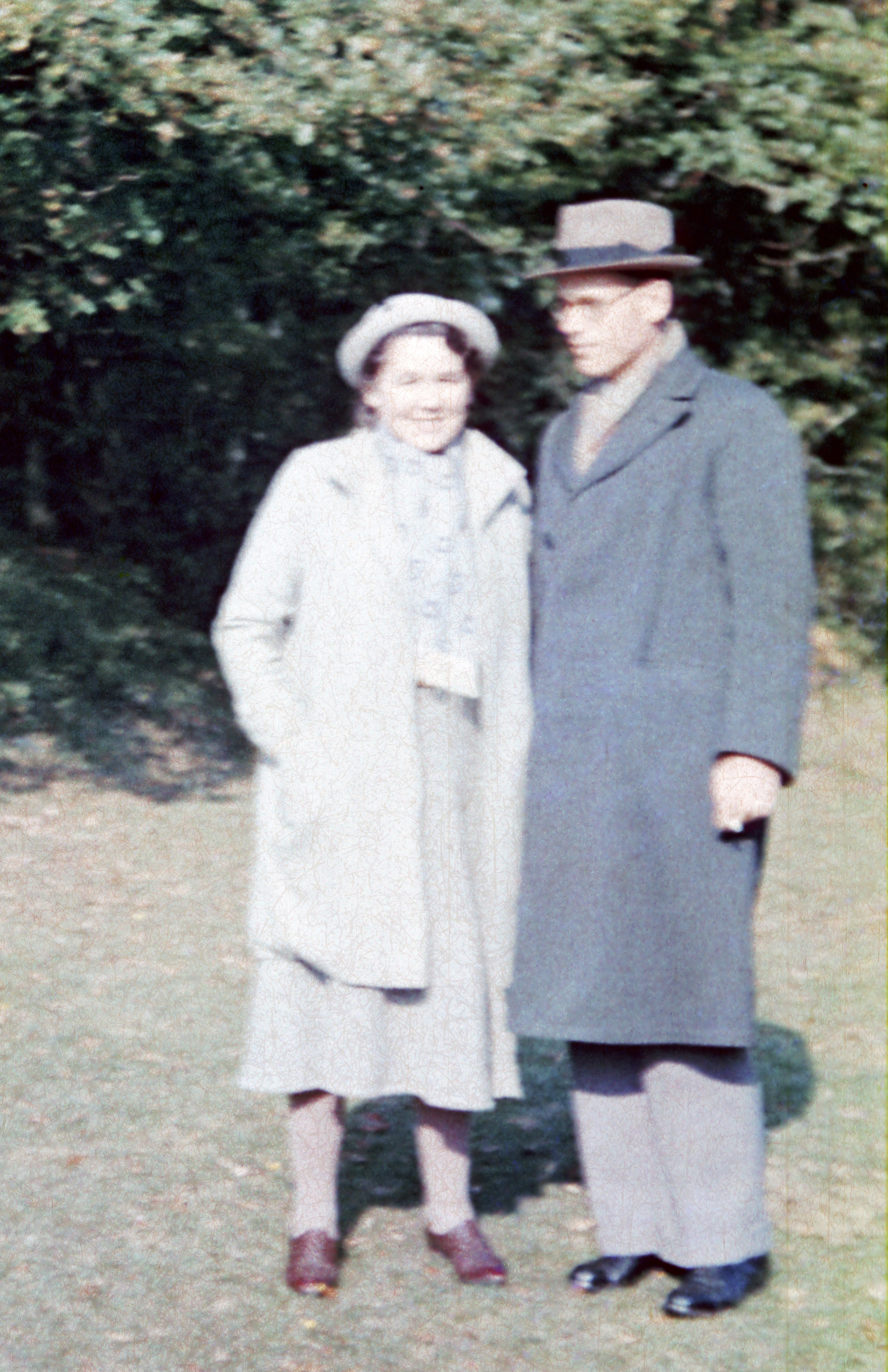
We started from Rustington, Sussex, on a lovely afternoon, and at nightfall arrived at a little village somewhere in Bedfordshire in pouring rain. At first my husband had driven very carefully, as he did not know how the caravan would behave when driving around corners and in traffic. He soon found out that his anxieties were groundless, as the caravan seemed to have no effect on the old Sunbeam. The main thing he had to remember was the extra length when he wanted to park in towns. We went faster and faster, and by tea time we had covered many miles. We stopped for tea in a pretty country lane somewhere near Watford. When I opened the door of the caravan, there was an awful mess; cushions, buckets, onions, meat, kippers, eggs, clothes and everything else we had in there were on the floor mixed up in a revolting pile. It looked as if some giant had thrown all our belongings on the floor and mixed them up with a spoon! We stood paralysed for a few seconds, then my family began to laugh, and I was quite ready to weep. However, we combined our energies and disentangled the chaos and cleaned things up as best we could. After that, we knew how to pack up for caravan travelling. We fastened everything securely, and in the crockery cupboard we always stuffed a cushion in and then shut the door and fastened it well.
At dusk it started to rain. We stopped outside a small village and asked the publican if he knew where we could put our caravan for the night. He looked at us very suspiciously and directed us to a little common, telling us that all the gypsy people stayed there, but there were none there that night. We pulled up under a tree. That was another thing that we learned by bitter experience: never park your caravan under a tree in the rain. Long after the rain had stopped, huge drops of water dripped onto the roof at irregular intervals, making terrible detonations. There was no sleep for us that night. Helen slept, of course, and I had to wake her in the morning to get a frying pan from under her couch.
The next day was much less adventurous; the sun was shining brightly when we started. We were making for Skegness, to spend two or three days near our friends who had taken a bungalow there during their children's school holidays. We went through the flat but attractive countryside of Lincolnshire and arrived at Skegness at lunchtime. We found our friends and put the caravan in their field. Skegness is another place where a lot of rock and other seaside food is consumed. We were five miles out of the town and often walked into Skegness when the tide was out.
After a few days in Skegness, we aimed for Scotland. We stopped in Lincoln to look at the magnificent cathedral. My husband took some photographs of the stone carving on the outside walls of the cathedral with his stereoscopic camera, which came out well. That night we stopped at a farm in Yorkshire, some eight miles south of York. The farmers who let us use their field supplied us with milk, eggs, vegetables and fruit. They came and talked to us in the morning, and Helen found some puppies in a hay shed and was very happy playing with them. The mother, an intelligent-looking sheep dog, stood by to see that they did not come to any harm.
It was Sunday morning, and soon after starting our journey we heard church bells ringing. When we got to York, we parked our car and caravan and went to the minster. It was a lovely bright morning, and the bells sounded very friendly and festive. We went around the minster, but we had no time to stay for the service. It was very impressive; I wish we could have had more time to see it. We liked the old town too, with its quaint narrow streets. The old houses bulged out towards each other across the street; some of them were so close on the second storey that by leaning out of the windows, two people could almost shake hands.
From York, we went through Northumberland and stayed the night about twenty miles to the south of Edinburgh, in the yard of a big farm. It was a very well-managed farm, and Helen was terribly excited about meeting the Scottish people. She was wondering whether she would be able to understand what they said and if they would understand her. While we were preparing things for the night and getting an evening meal cooked, she went out to explore the foreign lands.
She came running in out of breath, "Mummy, I have been talking to them, and they speak very much like we do! They have a Laird, and a wee coo. The Laird lives far away, but the wee coo is in the barn and it is a baby cow — a lovely brown one. I wonder if the Laird is something as nice?"
It was the agent who lived in the farm, and he and his wife were a very dignified middle-aged couple, and very kind. Helen took us around after supper to be introduced and to impress us with her knowledge of the new language. We had a pleasant evening with them — it was a Sunday evening and they were not busy.
On Monday morning we reached Edinburgh. We took the caravan up to the castle, parked it in front and went around the castle. It was wonderful to stand in those great big halls with massive stone walls in the most beautiful city in the world. The tiny panelled bedroom of Mary Stuart (Queen of Scots, I think) had the best view. The War Memorial was most impressive — those realistic sculptures of men, animals, and machinery arranged around the walls illustrated the great war so that even the most unimaginative could not fail to see how it was. It was truly a great monument, and I am quite ashamed to say that I don't remember who the sculptor was and whether it was done by one man or several.
After viewing the Castle, we went shopping in Princes Street, and what a handsome shopping street it was! Even Woolworth's was quite different from the thousands of other Woolworth's. We went into a baker's shop and bought lots of Scottish breads, cakes and pancakes to try. We left Edinburgh at midday for Aberdeen. We crossed the Firth of Forth on the ferry by the bridge. What a colossal thing the Forth rail bridge was. Span after span we passed, and each one was long enough to make a respectably sized bridge in itself. We went through Perthshire, into the mountains and over the Devil's Elbow. People told us that we would not manage the Devil's Elbow with the caravan, as it was too steep. We wanted to take that route to see Braemar, Balmoral and Ballater, so we decided to risk it.
After we left the woodlands of Perthshire, we came into the mountains. We were enchanted with the scenery. It was September, and the colouring was gorgeous; every mountain had a different coloured mantle ranging from many shades of greens to mauve and vivid imperial purple. When we got to the Devil's Elbow, our old Sunbeam said "It is hard work, but I will do it even if I blow the radiator cap off!" and she did, wheezing like a steam engine. We gave her a rest and got out of the car to walk on the soft turf. We climbed the nearest hillock and looked onto the other side. It was just after a shower of rain, and the air was so clear. We could see miles of colourful mountain, adorned with silver ribbons — streams which helped to make the River Dee.
We came back to the car and went on to see more of this wild beauty. Very occasionally we passed a shepherd's stone cottage. Helen thought it was hard on the milkman and grocer, having to go all the way in the mountains to deliver their goods, and she did not think there would be strong competition for the shepherds business. Her Daddy told her that they lived chiefly on porridge, and she was very sorry for them. At school when she was made to give up something for Lent, she gave up porridge, so I knew what she thought of that nutritious foodstuff. Coming down from the mountain, the view of Braemar nestling in the trees was very pleasant. The River Dee by this time was very wide, curving through the green woody valley. I could see why there were so many lovely old Scottish songs. Highlanders could not help but make songs of their beautiful countryside, and they remembered its wild beauty wherever they went. Balmoral and Ballater were both beautiful in the evening light, and we feasted our eyes on the Dee Valley.
After we had passed Ballater, the sun was setting, and we, like the birds, began to look for a place to roost. But at farm after farm we were told that they could not take our caravan, because they were only tenants and had not the authority to let us in. We were getting a little worried and tired after a long day of sightseeing. Luckily we met an AA man, and he took us to a small croft whose owner allowed us to stay the night. The field in which we camped was small and on a steep slope. We had an awful job to get our home and the car squeezed in; we could not get the caravan on the level however we tried. It was so pretty that we did not mind sleeping at a very odd angle.
In the morning we went on to Aberdeen, not a very long run. Aberdeen was a very tidy commercial town with solid-looking stone buildings. As we drove in, we passed through a residential area, and there were some very good houses with pretty gardens. Everybody was very busy and serious.
Helen said, "I want to see the place where they make jokes,"
and when she was told that there was no such place, she said she wanted a kilt and beret. We parked the caravan and went around the town to look for a kilt. Every shop we went into asked us what clan we wanted. We said we did not mind as long as the colours were pleasant. Helen was growing rather anxious as she could not find what she wanted. When we came out of one of the shops, we saw a car packed with kilts, and Helen saw one that she liked. The commercial traveller was just going to start the car, but we stopped him and soon the transaction was over.
The nights were getting cold, and we had not brought many thick clothes, so we all bought something warm to wear. Then we started off for Inverness and Loch Ness, where Helen hoped to see the monster. She was lucky — he was there. The wind rippled the water in such a way as to make long black patches on the loch which looked like a big monster wriggling in the water. We were glad we went there as it was lovely all around the lochs. The new road was being built, and we had some very worrying moments. The new road was cut out of the rock and was still very narrow in parts, and the caravan looked very much too wide for it. However, we got through without any mishap.
That night we camped in a big farmyard at the end of Loch Oich. It was early in the evening, and we left our dinner cooking and went for a walk on the old road that was condemned as unsafe. It was a glorious walk! The road was covered with moss and ferns and masses of wild flowers, and the view of the loch was unbelievably lovely. We were sorry to leave our wonderful site in the morning, but Helen only had one more week before she went back to school.
That morning we went through Fort William, which we liked very much — so spruce nestling in the mountains. We looked at Ben Nevis and came to Loch Leven. It was astonishing to see the chimneys of some works in that pretty place surrounded by the mountains at the corner of the loch, but everything was very tidy. After we left Loch Leven, we went through Glencoe Pass, and as we did not expect to meet a policeman there, and the road was so good with easy gradients, we forgot our regulation thirty-miles-per-hour speed limit and did sixty or more. Further on we saw some shooting parties, and we moderated our speed. The place was dotted with small lochs, like jewels among the hills in the sunshine. We saw the railway in one place, and though the line looked level, it must have been steep because the train was puffing very laboriously.
We came to Loch Lomond, and it was beautiful following the loch on the road which zigzagged around the wooded rocks. Helen was watching the speedometer. We had said when the speedometer read one thousand miles of our caravan trip, we would stop no matter where we were, and she could fire her toy pistol to celebrate. The speedometer moved to one thousand on a very narrow twisty bridge, without any view of what was coming. We had to stop, of course, and she discharged her pistol just as another car was coming onto the bridge! It managed to pass us, and the occupants gave us a "bit of their mind" — we deserved it!
In the afternoon we came to a wide road and unexpectedly saw Glasgow. The biggest object on the horizon, towering above everything else, was the Queen Mary, which was still being built then. That view of the city was very fine, and even the factory chimneys did not spoil it. We went through the city without stopping, except at traffic lights and to inquire the way. After leaving Glasgow, we drove for about thirty miles when we saw a promising-looking farm and stopped to ask if they would let us camp for the night. They did, and supplied us with milk, eggs, fruit and vegetables. It was a large family, mostly boys, and everything was run by the invalid mother, who had been bedridden for five years. She was a very clever woman and used her head even if she could not use her limbs.
She wanted to see us all, and we went one by one to talk to her while the others were getting the dinner ready. The whole family was interesting; they all went to Glasgow every day, some to school, some to work, but when they got home they worked on the farm. They were harvesting oats that night until quite late.
The old lady asked Helen to write to her after she got back to school, but I am afraid she only wrote to her once as it made her miserable to think of the poor invalid lying in bed all the time, only viewing the world reflected in the mirror fixed over her bed to give her the view of the road. She saw us in that manner too, before we came into her room.
In the morning we said goodbye to these people and went on our way to Cheshire to stay with our friends for a few days.
We went through the Lake District. I wish we had gone that way to Scotland, as we would have appreciated it more. After seeing the magnificent landscapes of Scotland, the lovely miniature views of the lakes were lost on us. However, we could not but admire the pretty surroundings of Ullswater and all the scenery around Windermere. Everything was so green, and the houses nestled cosily in this paradise. Now and then a waterfall went cascading down rocks covered with ferns and other plants. The day was sunny, and everything looked cheerful and clean. Later on in the day we passed through Lancaster and other busy towns where our caravan was very conspicuous and people stopped to look at us. Folk did not often go on caravan trips around those parts.
After a few days we got back to Sussex. I was busy preparing Helen's school trunk, a job that always took me by surprise. When the trunk had come back from school at the end of term, I had looked in and found everything so tidily folded, with tissue paper between the layers of clothes, that I thought it was a pity to disarrange it. I shut the lid and never thought about it all summer. When we came back from our caravan trip, I opened the trunk and looked over the list to see what alterations to her wardrobe we had to make for the winter term. The alteration was very simple: Scrap the whole lot and get her a new one.
I told my husband about it, and he put on a very worried expression. He looked at his bank passbook and was still more worried. He told me (like many times before) that I should have seen to Helen's trunk when it arrived and bought the things at the beginning of the holidays, before we had spent the money. This conversation was in whispers, because we were staying with my in-laws and we did not want them to know that we were "poor relations." We had just enough to pay the school bill which was nearly due. After we had exhausted ourselves convincing each other in whispers that it was the other's fault, I retired outwardly with dignity, but in reality defeated, to my room, to think what was to be done.
First of all, I went through all our pockets; that only brought me one pound and ten shillings. I opened our "office box," and amongst the passports and birth certificates there was one envelope marked "Savings." We had drawn the capital out of it years ago, but I thought I had better look. In one Post Office book I found three shillings and sixpence left. There was also a book of war certificates that I had bought years ago with money given as a wedding present by my husband's aunt. I knew I had dipped into it very thoroughly at difficult moments, so I did not have much hope. However, I took both books to the Post Office and told them that I wanted to hand the books over and take everything out, so that I could start a new account. They told me I had to fill in a form, and they would send it to London. In two days' time I received a communication that there was the magnificent sum of twelve pounds awaiting me at our Post Office! Miracles still happened even in those days. During these two days I was busy making Helen's clothes from mine, and I don't think she liked the idea
She said, "Mummy, it is a pity to spoil your pretty things to make clothes for me."
What she meant was that she did not want home made clothes; she wanted some that came from a good shop, as good as other girls had, and better if possible.
The twelve pounds miracle simplified matters considerably, and in a couple of days all was ready and the trunk was despatched. On Saturday afternoon we took her to school with bunches of flowers for her house and enough sweets to make a camel sick. I believe the girls pooled their confectionery and ate it all while talking of their holidays and examining the new arrivals.
The days seemed very long to us after she returned to school, but we took her out on Sundays and she gave us a list of things that she "must have" every week, which kept us pretty busy from one Sunday to another. Also, we were doing our own shopping for the coast. The weeks went by very speedily, and once more we went to Liverpool, and on a foggy November afternoon sailed for Nigeria. The passengers were nearly all the same ones that had come home with us. We soon settled into our routine on the boat. In the morning some played bridge, some sat in deck chairs and read, some just chatted, and a few played deck games; at eleven o'clock there was always an auction of sweep tickets, and the time passed to one o'clock and lunch.
After lunch, passengers had a siesta, either in deck chairs or in their cabins; all was peace and quiet until four o'clock — teatime. Occasionally there was a crowd of young newcomers, and they couldn't think how anyone could vegetate like that, resting in the afternoon. They talked and laughed gaily, and the old coasters gave them murderous looks for disturbing the peace that their jaded nerves needed. After tea things looked more lively; some went for a walk around the deck, but most played deck games. After games, people gathered in groups, ordered drinks and chatted or played bridge until the dressing bell. Bath and dinner followed. After dinner there was always a dance, dog racing or some other show unless we were in port.