Chapter 10: Another Tour - Chickens and a Derailing
When we came back to Nigeria, we were sent to the construction headquarters at Kakuri, near Kaduna. The secretariat of the northern provinces is at Kaduna, and the assistant commissioner lives there. The construction houses had mud walls and grass roofs and were not furnished. We soon made ourselves comfortable by borrowing a few things and using packing cases as chairs, tables, and even chests of drawers. I liked the houses. They were cool and were easy for the house boys to keep tidy and clean: no floors, tables, or chairs to polish; the mud floor needed only a sweep and a sprinkle of water, and the cases just a rough dusting. We got our Persian rugs and brasses out, and the house looked like an Arab sheik's tent. The construction was nearly finished, and the staff were being gradually dismissed; the last two of them (an engineer and paymaster) went home soon after we arrived. They sold us a few pieces of rough furniture that were very useful, and some lamps and other odds and ends.
We liked Kakuri; the houses were built on the top of the hill, and we all had a fine view. There was a tennis court, and we all assembled there in the evenings — some playing, others watching. After tennis, we usually went to someone's house and had drinks and hors d'oeuvres while we talked or listened to gramophone records. I used to go out for walks in the mornings and sometimes went to the bush with my husband while he was doing surveys. He had been posted to work in the office as a personal assistant to the engineer in charge because he was not yet well enough to go out trekking in the bush all day. There were several engineers arriving for the survey work, but the chief engineer decided that he did not want anybody in his office, which meant that my husband had to walk about all day long in the sun surveying. After a month of it, he went down with fever. They took him to Kaduna hospital one Saturday night, and I wept all night and Sunday morning. Later, some friends came and took me in their car to visit my husband. He was slightly better, and I was much more cheerful. My friends insisted on putting me up and were very good to me. I stayed with them a week, until my husband came out of hospital. He was very weak, and the doctor put him on light duties, but the chief engineer still did not want anybody in his office. That left only survey work to do, and he was not yet strong enough to do that, as he still ran temperatures in the afternoons. He asked for a transfer, and we were sent to Aro, which is about sixty-five miles from Lagos.
I was sorry to leave Kakuri. I liked it very much; we were very friendly with everyone except the chief engineer. We arrived at Aro at four-thirty in the morning after about thirty six hours on the train. The engineer of this section was sick in hospital, so there was nobody to give us tea or breakfast. The native foreman came to meet us with his gang of labourers and took us to the rest house belonging to the Public Works Department. There was some furniture, so we went to sleep for an hour. The boys got busy unpacking some of our things, and when we got up, we had breakfast.
The engineer came out of hospital a week after our arrival. He stayed in his house for another week, writing handover notes for my husband. When he did leave, it was nice to get into the house. It was very old and small and too near the village, but it had a lovely view, and we were very happy there. The house was raised up about five feet from the ground, and I had a hammock underneath it. Every time I walked under the house, I used to bump my head on one of the beams. I had a permanent lump on my head for a long time afterwards.
We had a tennis court, and we used to have tennis parties with people from Abeokuta, about five miles away. Abeokuta is a big native town where the Alake (the chief of the Egba people) lives. He is a very sociable man who funds public functions of any kind and often entertains Europeans in Abeokuta on a grand scale. We attended one of his tea parties, which was given in honour of Mr. Adams, the Resident, who was retiring. It was a very good show, and we enjoyed it. Another time, we went to see the Centenary Celebration film, which a doctor had made at the time. He was showing it one evening in the town hall to the Alake, a few Europeans, and seemingly the entire population of Abeokuta. When we arrived, we were entangled in a crowd and were carried towards the entrance of the hall. We were helpless and could not do anything. When we got near the door, the policemen were beating everybody on the heads with their truncheons to stop them from entering the already full hall. My husband avoided a blow on the head, and we gathered all our strength and extricated ourselves from the crowd. When we finally got in, we found the hall was packed and there were no seats for us. There were several European women, and we stood for about an hour in the dark. The crowd outside gradually got quieter, and when things had thinned a little, we slipped off and went home. That was not such a good show, but we should have guessed what it would be like.
The rest house was very near to our house, and it was useful being able to send our guests to sleep there, as we often had people from Ibadan and Lagos staying. We had two rail cars converted for travelling: one as living accommodation and the other a kitchen and the boys' room. Travelling was much easier that way. We had a sitting room and a big bedroom, part of which we screened off as a bathroom.
My husband used to go on the trolley in the morning, and the coaches would be picked up by some train and brought to the station to which he was trolleying. Sometimes the coach was shunted into a siding by the engine; at other times, it was left on the line to be hand-shunted into a siding. All the stations on this section were noisy and smelly, so I had to supervise to ensure that they put me in the quietest and most fragrant spot. Once, I was being shunted by the engine at the end of a long train, and the native with the flags who was directing the operation got mixed up and showed the yellow flag when he meant the red. As a result, our coach was pushed through the stop block and off the rails. The native driver, the guard, and the pointsman all came and looked at it and said, "Ah, Ah." They asked me what they should do. I told the driver to get on to the engine and pull the coach back onto the line. He did so, and the wheels of the van were railed again. They all came back again and said, "Ach! Ach!" I got my cook's mate to put the stop block straight, as it looked untidy like that, and all was well.
When my husband got back in the evening, I told him of my good deed for the day. He did not approve! He said that next time anything like that happened, I must send for the station master, and he would follow the usual routine and send a wire about the derailment. That meant that my husband would have to come with the breakdown van, the loco foreman, the traffic inspector, and perhaps more people. I agreed, outwardly penitent, but I was really very proud of my own derailment. I should think that I got the wagon back onto the rails again in record time! I will admit that it was a miracle that the wagon's wheels came on again after they had been derailed for about five yards in soft ground. In theory, it was impossible, but I did it. One can get away with anything once!
My husband's section went from Ebute Metta (Lagos) to Ibadan, and we lived halfway between at Aro. There are a lot of stations on this section, but we only stayed at places where engines stopped for water, which are thirty miles apart. There was Olokemeji, which I liked. It used to be a forestry headquarters. There are miles of teak plantation and other trees. There were a few houses, and the roads leading to them had flowering shrubs and trees and looked very pretty. We enjoyed our walks there. It is so nice to walk on good, clear paths. There is a river at Olokemeji that cuts between two steep hills, and the railway runs across it on a bridge with the station about half a mile distant. Olokemeji in the Yoruba language means "two hills." The hill nearest the station is very steep, and I wanted to walk to the top and take in the view. I asked the trolley boys to show me the path leading to the top, as there were many paths through the forest.
They said, "Missis no fit go there. White man go there, he never come back. Two white men go there long ago, they never come back!"
So I was very curious and wanted to visit. I also heard that the general manager's rest house used to be there years ago, and I liked nosing around old derelict buildings. There are few ruins in Nigeria; the white ants and bush soon level everything when the place is not looked after. But I never managed to get to the top of the hill; they would not show me the path. I asked the station staff, and they told me the same story.
The next station where we occasionally stayed was Shanusi, which was on an old trade route used to drive cattle from the north. It runs for hundreds of miles, and I believe can only be travelled during the dry season. The villagers at Shanusi grow very nice little onions, called "Shanusi Onions," which are very good pickled.
The first place we stayed on the Lagos side from Aro was Itori. Two European trading agents and one Public Works Department engineer lived there. All three men were charming, and we had many pleasant evenings together. One day, when we arrived, we found one of the agents in great distress. He had been drugged the night before, and forty pounds (the 2025 equivalent is £3400) of his own money had been taken from his safe. He said it was done by a gang of thieves, but I think that his boys knew something about it. There used to be many cases of Europeans being drugged, but it is not very common now.
Once, when we were at Itori, one of the agents offered to take our photos, so I put on a period dress I had made for the coming New Year's dance at Lagos. When we were ready, the cook's little boy ran out of his hut to look at us. We asked him to come and hold my train.
We sent the photo to Helen, and I heard afterwards that she was very indignant: "They might have given him a shirt or something to put on!" she said.
I am afraid we did not even notice that he had nothing on, as we are so used to seeing native children naked. One often envies them for that when it gets unbearably hot and sticky, but I am afraid that the average European out here (man or woman) would not be as easy to look at as the average native. One very seldom sees a fat native from the bush; in fact, I have never seen one. If a native is fat, it is usually somebody who works for a European.
A further thirty miles along the tracks was Kajola, where we used to stay — a dreadfully smelly and noisy place. The nearer you get to Lagos, the dirtier the villages around the stations are. There are no pleasant walks there; each path leads to a village, and the natives you meet are not very respectful or polite. They are very prosperous, as a great deal of cocoa beans and kola nuts are grown in the district. I never looked forward to going to Kajola.
Once a month, we used to visit Ebute Metta Junction, the next settlement along the line, for the pay train. I usually spent the day with some friends at Ebute Metta or Lagos because it was very hot, and the pay train journey to Ebute Metta Junction was no novelty to me. We had many friends at Ebute Metta, and when we came, we were always asked out to dinner or taken to the sea for a bathing picnic, which we appreciated very much.
Once, we were asked to join a bathing picnic party by my husband's manager's wife, Mrs. A. We had already promised to spend an evening with a friend who was missing his wife, who had returned to England, so I asked Mrs. A if we could bring our friend along, and she happily agreed. When we joined them in the evening, I found out that she knew and did not like our friend, and she plainly showed us that we had better amuse ourselves on our own. We did and went down to the beach, bathed, and were quite happy some distance away from them on the sand. Later, they lost a surfboard, and the waves had brought it to us, so we were having fun using it. After a while, Mrs. A came and asked us if we had found it.
I said, "Yes, here it is," and as she reached to take it, a strong wave came along and swung me and the surfboard right around.
The board made a hearty smack on the lady's bottom! Mrs. A went down on her knees in the sand, and when I got her up and apologised, she was very indignant, as she thought I had done it on purpose. How could I? She was my husband's boss's wife, and I would not risk his employment by such a hasty act, even if I had wanted to. She forgave me later when she saw my Rhode Island pullets, which were very fine, and as my pullet farm was multiplying faster than we could eat them, I let her have some with pleasure.
I enjoyed my poultry farming at Aro. There were a lot of trees in the compound under which young chicks could run when a hawk swooped down. The hawks were a nuisance; one lost half the chicks before they matured. The natives dye their chicks red, as hawks are supposed to be deterred. I should say it made them a rather horrible pink, and at first, I thought it was a special breed of poultry. One morning, I saw them being dipped, and they were very sorry for themselves, looking as if they had been dipped in blood. There is a chicken one often sees in Nigeria whose feathers grow the wrong way round, sticking out towards the head and not lying smoothly towards the tail in the usual fashion. I think their feathers grow like that naturally and are not trained in that direction by the natives.
The natives had an invariable habit of carrying their chickens upside down by the legs. The chickens went miles in that position. It is against the law now, but I have not noticed any difference yet. I have never seen a Nigerian native making the least effort to relieve discomfort to an animal or a bird or to any living creature, unless it was in danger of losing its life. Then the owner would intervene because it involved a loss of money. I think it is just lack of imagination, just as children can be cruel because they cannot conceive of someone else's discomfort. It is very unusual to see a native feeding chickens or any animal; they all have to find their own food. Luckily, they can usually find enough to eat to keep them alive. The Nigerian chicken is like a bunch of old tennis racket strings wrapped up in a piece of parchment, and its only resemblance to a domestic chicken is that it has a strong smell of the farmyard.
Some years ago, the wife of an agricultural officer at Ibadan brought out some Rhode Island Reds and sold many of them to Europeans all around. This improved the strain of the native chickens, and now you see many good-sized birds between Ibadan and Lagos. When we were going on leave, I divided mine up among the native railway staff after they had promised me that they would look after them. I told them that if they fed them, they would get plenty of eggs and also big birds to eat, which they could sell for much more than the small, starved local chickens.
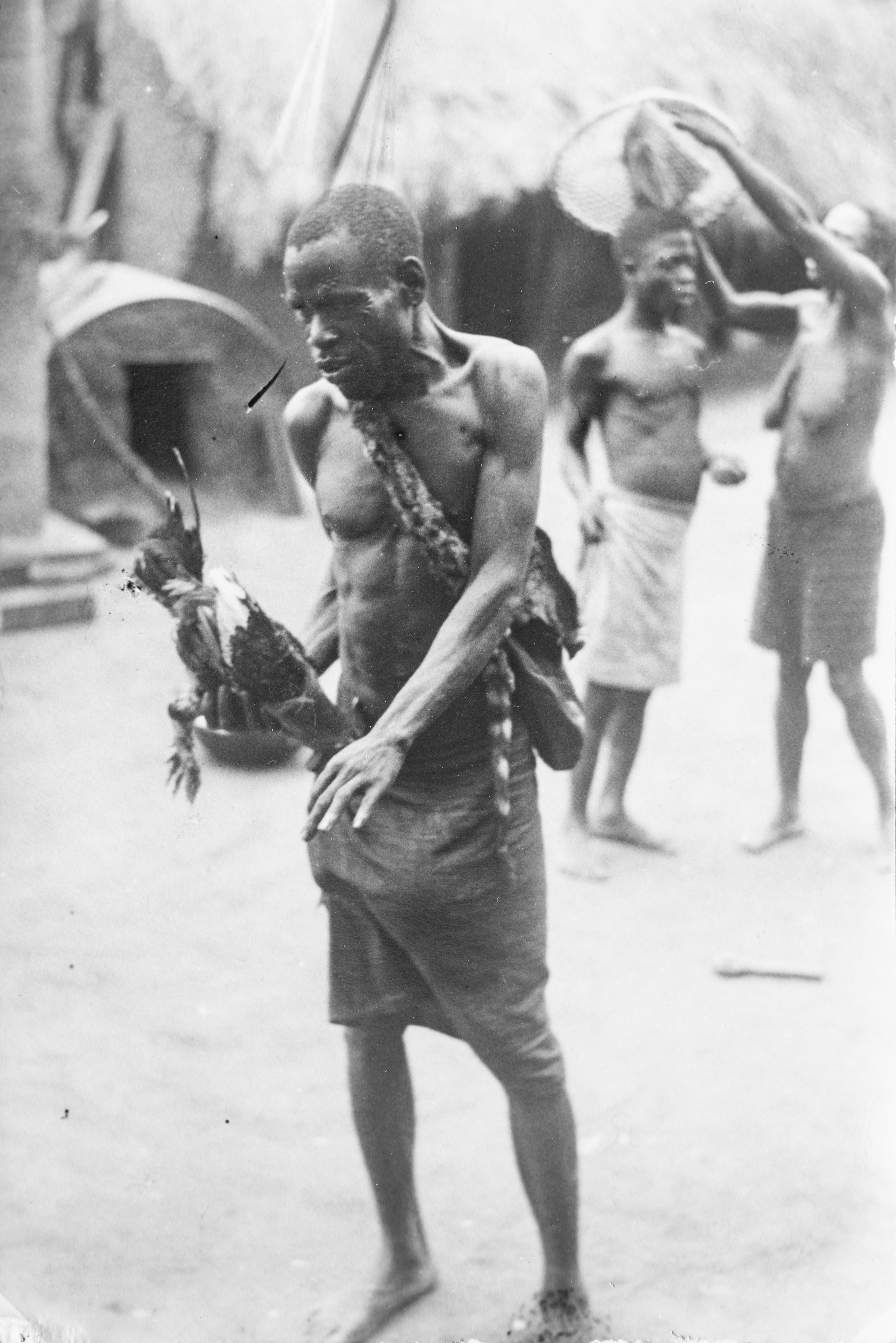
I think they looked after them because when we passed through Aro at different times, I saw some very good hens and cockerels walking about. However, I nearly got them back the day after I had given them away. When I looked out of the bedroom window the following morning, I saw all my hens and cockerels were back again, and they looked at me very reproachfully. So they might — they were an extraordinary sight! Some had their tail feathers plucked, others their head plumage, and they had lost feathers from many different places on their bodies. Poor things! I felt very cross that they had been so roughly treated. I sent for the owners and asked them what was the meaning of it. They explained that as they lived near to each other, the chickens might get mixed up, so they had pulled out their feathers in different parts to mark them and so stop disputes about ownership. I was very cross with them and told them that they had done a cruel and stupid thing. I told them that if they gave their chickens plenty of food and water and a place to sleep in, they would never leave. I hope they took my advice.
I shall never again give anything alive to a Nigerian native, not even vermin. I could only allow them to deal with cockroaches without my sensibilities being hurt, but unfortunately, they don't notice cockroaches. Sometimes we got a coach that was full of cockroaches, and until I had cleared them out with borax and sugar, they made my life miserable. I am always so afraid of bringing them into the house in our chop boxes. So when we pack and unpack, I tell the boys to watch carefully and kill them, but they never notice unless I stand over them.
I contracted an ear infection from bathing in Lagos, and towards the end of the tour, it worried me a great deal. I used to get quite deaf for days at a time, and it was painful too. Nothing could be done until we got home. One evening, we had arranged to play tennis in Abeokuta. My husband took some money out of the cash box and threw the key on the bed, telling me to put it away. But due to my deafness, I did not hear him, and we went out for the evening. When we got back later that night, I wanted the key so that I could pay the cook for shopping at the market the next morning. After a lot of trouble, we found the key under a book on the table by my bed, but when I went to the box, it was empty. So we had to dismiss our head boy because we knew it was he who had stolen the money. He knew that we knew, so we had no alternative. I was sorry because he was the most intelligent boy we ever had. For a long time, I had shut my eyes to petty pilfering, not wishing to part from him, but this time he had to go. During the rest of the tour, we employed many boys, one after another. Sometimes I engaged a boy in the morning before breakfast, sacked him after breakfast, got another before lunch, sacked him halfway through lunch, and got another one in the evening. I was astonished to find out how many boys want a job as a house boy; the supply was inexhaustible, and there was almost a queue in our compound.
There was an old "Hausa" boy from Northern Nigeria whom I tried for a few days. He was a nice, quiet old man, but he could not remember anything; when we sat down to a meal, there were always a lot of things that he had forgotten to put on the table. Once, we sat down to dinner, and there was no bread on the table; the bread board and the knife and fork were there, but no bread. So we told him that he had forgotten the bread again.
He said, "I put him there, Sah!"
My husband told him not to be silly and to bring the loaf, but the boy persisted in saying that he had put it on the table. So we got up to investigate; there were some crumbs on the table and some on the floor, so we followed the crumbs and found the loaf in the next room behind a big packing case, and a big rat was having supper off it. There was also a piece of soap and a shaving stick whose disappearance my husband had blamed the boy for.
I told this story about the rat and the bread once at a morning sewing party at Ebute Metta. One woman was very upset about it, and when her husband came home that afternoon, she wept in his arms and said I had been frightening her. She had just come out as a bride, and she had never seen such a thing as a rat and would certainly be very ill if she did see one. I hope she has not seen a rat yet, or anything worse. I am sure I have seen many worse things than a rat, though I don't like them any more than she does.
One day, I had some boys cutting grass in our compound, and they came to me to say that they had found a big python asleep in the grass. I went to have a look and saw a thick coil of it showing just above the grass. I told them to leave it alone until they could get more people to deal with it. However, one boy jumped forward and gave a terrific swipe with his machete and cut the snake in half. It never moved and was revealed to be a large puff adder; one coil of it looked much like the coil of a big python. It was about six feet long, and the boys cut off its head and tail for "medicine." Puff adders are very dangerous; they are sluggish and do not glide away as most snakes do when they hear your footsteps. Their poison is fatal, and the victim bleeds to death. I knew a native policeman who died from a puff adder bite in Makurdi.
Once, I was busy writing my home mail, which I had left until the last moment. Suddenly, our house was filled with bees. They came to my desk, trying to swarm in all the pigeonholes. I quickly shut the top of the desk and went to bed under the mosquito net for safety until my husband came home for lunch.
The boys were laying the table, and the drawers and doors of the sideboard were open, so the swarm migrated from the desk to the sideboard, and the boys had to disappear. When my husband came home, he cleared them out in five minutes by burning some crushed cigarettes in ashtrays and firing pieces of newspaper. They did not like the fumes and left the house. But it annoyed them so much that they went into the foreman's compound and killed some turkeys, chickens, two parrots, and chased the boys away. They settled in the roof of his house, and it was very difficult to get them out. He could not go into the bathroom for a couple of days, as they were just above it, and every time he went in, a few of them would come out and sting him.
The sand flies were the worst, I thought, as they annoyed me all day long. They are so small that one can hardly see them, yet they sting like red-hot cinders. But one forgets all these things as soon as one gets onto the boat to go on leave. Our leave is like the carrot in front of a donkey; it keeps us going. We save up for it, we plan for it, and when we come back, we talk about it until we have done half the tour, when we start to plan for the next one again.